Category: University News
Title: President Peñalver’s Inaugural Address: We’ve Forgotten How To Argue. Here’s How We Can Argue Well
Date Published: October 14, 2026
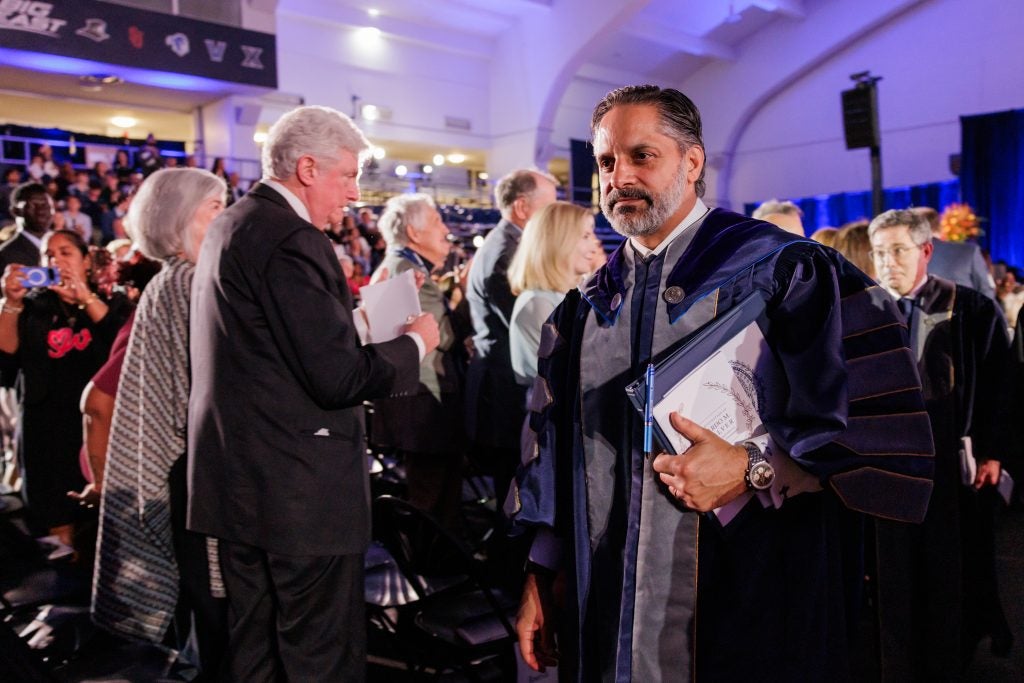
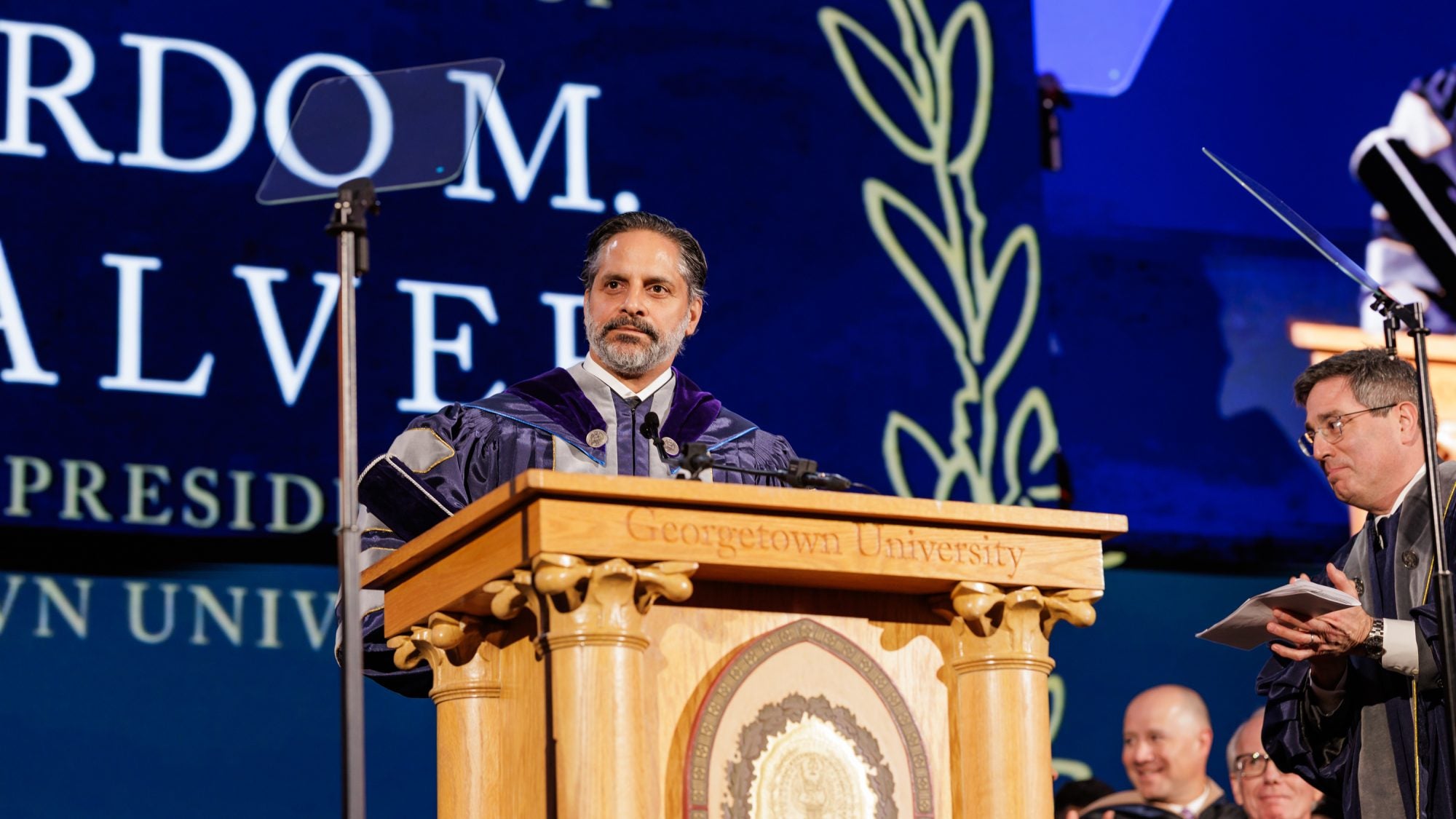
On Oct. 9, Eduardo Peñalver delivered his first address as the 49th president of Georgetown.
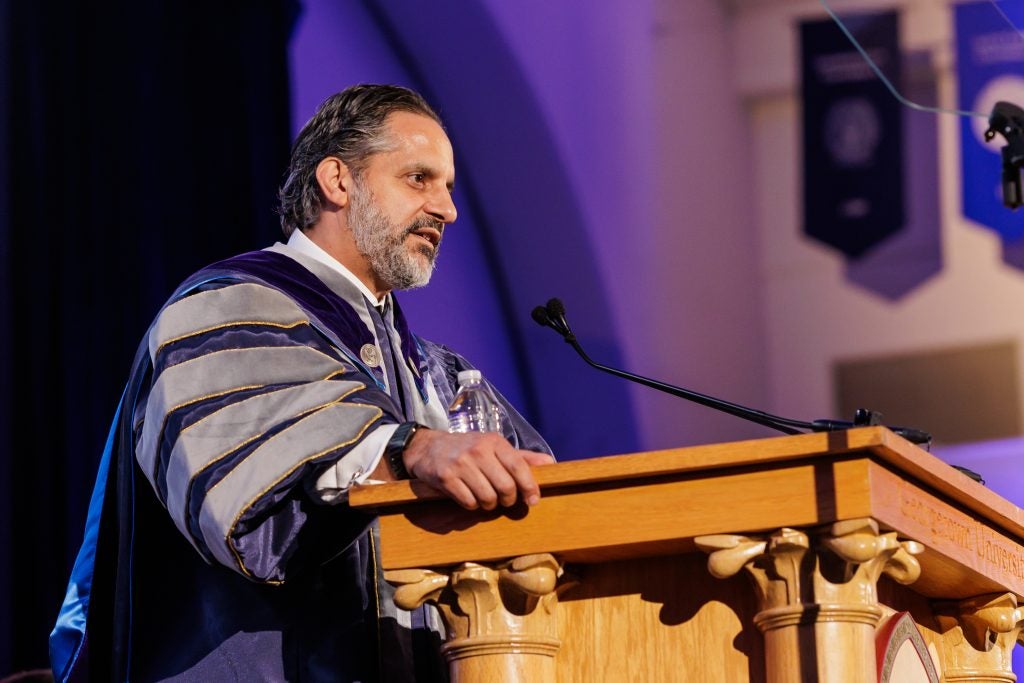
During his inauguration ceremony, Peñalver spoke about how Americans have lost the art of arguing – and three ways we can foster healthy, productive arguments for the betterment of both universities and of society. Below is an excerpt from his speech. For the full text, visit the president’s website.
Among our society’s many challenges today, one of the most grave is that we have forgotten how to argue. “How can that be?” you might be asking. All we seem to do these days is argue.
But the all-caps, bumper-sticker vitriol we experience on social media is not a model of “argument.” It’s a failure of argument. It’s telling that a common response to disagreement these days is to “go no contact.”
What Gilby had in mind when he equated “argument” with “civilization,” and what I am talking about, is something very different: it’s a contest of big and important ideas according to shared standards of reasonableness.
Viewed in this way, we can understand an “argument” as an intense and high-stakes species of “dialogue.” Defending (and practicing) a positive model of argument is essential for a country where deep disagreement has been our reality from the beginning.
After all, what are the alternatives?
The great American Jesuit, John Courtney Murray, S.J., whose papers are preserved in the Lauinger Library and whose book, “The Problem of God,” was an inspiration for Georgetown’s legendary course of the same name, observed that “pluralism” – which is to say, deep disagreement about important issues – is America’s “native condition.”
And the same is true of Georgetown.

Founded by John Carroll as a Catholic university in what at the time was an overwhelmingly Protestant country, Georgetown has always welcomed people of all religious faiths. And Georgetown’s original embrace of pluralism was at the same time an embrace of argument. Why would we do that?
Jack DeGioia put it well in his dissertation: “[t]o have confidence that our [own] tradition is in good order, we must continuously test [its] strength and coherency….” by exposing it “to the maximum possibility of refutation.”
Murray believed something very similar about our Republic: the values that hold us together across our many differences can only survive if we “constantly” argue them out, he said.
So my contention is that argument, understood as a species of dialogue, is a good thing. In fact, it’s an essential thing for a pluralist society and for a university. But what does it take for an argument to be healthy and productive rather than toxic and corrosive?
Argument, understood as a species of dialogue, is a good thing. In fact, it’s an essential thing for a pluralist society and for a university.
Above all, it must be civil. By civility, I am not talking about some precious commitment to politeness. The Oxford University philosopher Teresa Bejan argues for what she calls “mere civility,” which she sees as a minimal floor for dialogue rather than an extremely demanding barrier to entry.
Civil argument can still be unpleasant argument. But for a university community, civil argument does require a shared commitment to reason and reasonableness.
Murray described several ways in which arguments cease to be civil or reasonable: When participants collapse into solipsistic navel gazing – into the conviction that my insights are mine alone and cannot be shared or understood by others who do not share my beliefs or identities; when people only expose themselves to views they already agree with, refusing to engage with those who think differently; and, most catastrophically, when the very idea of reality of a shared truth collapses.
This last point is vitally important. Murray warned that if we give up on the idea of a shared truth, “no assertion may claim more than the status of mere opinion.” That if everything becomes mere opinion, the only basis for favoring one conclusion over another is the raw assertion of power. Ultimately, that is the antithesis of argument and of civilization.
So the first requirement for argument to be healthy is civility, which in turn requires a commitment to engagement and to the possibility of a shared truth.
The second requirement is diversity. It takes two to tango and at least two people to have an argument, but the argument can only happen if they disagree. Where there is not a diversity of opinion, arguments peter out or become narrow and vapid. Inside the bubble of homogeneity, agreement may feel like common sense. But viewed from outside, it will be obvious that the consensus is unearned.
Georgetown’s history with slavery is a good example. The story of the 272 men, women and children held in bondage by the Maryland Jesuits and sold – literally down the river – in 1838 to raise money to (among other things) shore up Georgetown’s finances, was never a secret. It wasn’t discovered by the New York Times. It was a public act, well known to those familiar with Georgetown’s history.
But it is no coincidence that the issue became more salient as the Georgetown community became more diverse. Over the past decade, Georgetown’s reflection on its history, and its sustained engagement with the Descendants of those 272 (some of whom are now Georgetown alumni) has become a model for the pursuit of truth and reconciliation.
We are stronger for it. But the work is not done. And I look forward to honoring the 10th anniversary of the beginning of that ongoing journey later this year.
Georgetown’s work with the Descendants is an example of how the diversity of identity enhances the diversity of perspectives; and how that diversity of perspectives in turn enriches the campus environment. Both kinds of diversity are important. The old joke about two Jesuits having at least three opinions illustrates how being open to different points of view is an essential expression of our Jesuit values.
A final requirement for healthy argument is that it be animated by a sense of purpose. Without meaning, there can be no meaningful argument. That is tautological but still worth saying. If nothing has meaning, why bother arguing?
Fr. Alfred Delp, S.J., was a Jesuit priest executed by the Nazis in the closing weeks of the Second World War. In diaries he wrote while he was awaiting his execution, he reflected that “life… by itself has neither purpose nor fulfillment.” But at the same time, he insisted, “life demands both purpose and fulfillment.”
For Catholics, creation and incarnation infuse the world – and our arguments about it – with significance. As the Jesuit Teilhard de Chardin put it, “nothing here below is profane for those who know how to see.”
From all of this, it follows that a great university built on the Jesuit educational tradition should be great at arguing.
As a Jesuit Catholic university, Georgetown understands truth as a unified reality toward which the many disciplines tend, each in their own partial and distinctive ways.
As a Jesuit Catholic university committed to the belief that all human beings are created in God’s image, Georgetown welcomes and embraces the many diversities of the human community.
And as a Jesuit Catholic university, Georgetown excels in the search for meaning, and in kindling the excitement of that search among our students, who go on to put their learning to work in the service of others.
Some universities, seeking an illusory ethos of neutrality, have abandoned the aspiration of “making the world a better place,” even removing it from their mission statements.
Georgetown remains firmly committed to our Jesuit, Catholic “why.”
… This past summer, our nation celebrated its 250th birthday. Even as we celebrated, it was apparent that, as a country, as a people, we have forgotten how to argue, or at least how to argue well. We have forgotten how to “reason together.”
Thirteen short years from now, Georgetown will celebrate its own 250th birthday. What will our birthday gift be to our Republic and to our world?
For Georgetown, a university founded in 1789 in the spirit of a new Republic, a Republic that is now 250 years old and showing its age.
For Georgetown, a university committed to the search for truth; dedicated to celebrating the diversity of God’s creation, and to teaching our students about the deeper meaning to be found in the service of others.
For Georgetown, the most fitting gift we could give to our Republic (and our world) would be to help it discover how to reason together. How to once again enjoy a good argument.