Category: University News
Title: How Ignatian Spirituality Prepared Eduardo Peñalver To Be Georgetown’s Next President
Date Published: July 23, 2026
In the weeks before Eduardo Peñalver became the 49th president of Georgetown University, before his cross-country move to Washington, DC, he stepped away from his desk. And into silence.
In April, Peñalver went on an eight-day silent retreat along the rocky shores of the Atlantic Ocean. He traveled to a Jesuit retreat center in Gloucester, Massachusetts, and stillness was a mode he welcomed.
“I’m a naturally introverted person; I love the excuse to be silent. It’s like a luxury,” he said. “I find it helpful in deepening my own understanding of the work, but also, it’s refreshing. It’s restful.”
During this retreat, Peñalver’s focus wasn’t just on respite.
As he ran along the coast, prayed and read Scripture, and met with a spiritual director at the Gonzaga Eastern Point Retreat House, he contemplated his next transition: In what ways could he lead Georgetown, a 237-year-old institution, the first Catholic and Jesuit university in the U.S., into its next chapter?
“Georgetown is this precious thing, for the Jesuits, for the global Catholic community and for the country,” Peñalver said. “It’s doing something no one else is doing. What are the things I need to be doing to prepare myself to do well, not for myself, but to help this institution continue to thrive?”

Peñalver was in the right place for those questions. His retreat was informed by Ignatian spirituality and the Spiritual Exercises, a handbook of sorts that St. Ignatius, a 16th-century saint and founder of the Jesuits, created to help participants draw closer to God and find inner freedom to make important decisions.
The Washington state native had attended eight-day Ignatian retreats in the past: before he became president of Seattle University and during his Seattle presidency. The experiences proved formative, he said.
“The [Exercises] tie my decision-making and my thinking about leadership into a deeper significance and an extended tradition of reflection,” Peñalver said. “I’ve found them very centering and a productive form of spiritual practice.”
Silent Retreats and Leadership

Jesuits and laypeople alike attend silent retreats at Jesuit retreat centers across the U.S. every year.
The element of silence is critical, said William Campbell, S.J., rector of the Georgetown Jesuit community and Peñalver’s former spiritual director during one of his retreats.
“On a retreat, if we strip away all that external noise with silence, it allows us to hear the internal noise,” he said. “What’s it saying to me? What’s it inviting me to do? Unless I’ve stripped away the distractions, I’m less likely to be attentive to what’s happening within me.”
For Jesuits, this deep listening leads to discernment, which begins with noticing your emotions, thoughts and desires in the presence of God and seeing where you’re being drawn to.
This practice is particularly powerful and practical for a leader, said Fr. Gregory Schenden, S.J., director of Georgetown’s Campus Ministry.
“Reflection is empowering,” he said. “When we react, it’s almost like triage. It’s responding to something external rather than allowing, in freedom, my actions to come out of who and whose I am. [Discernment] is an incredibly important quality for a leader who’s guiding a community like Georgetown: to be grounded in something that is transcendent.”
Setting aside time for retreats is indicative of Peñalver’s commitment to his prayer life and Ignatian spirituality, Campbell said.
“I feel he’s making the retreats because that is by definition who he is in a relationship with God, and I hope that would bring comfort to the Georgetown community to know that their chief executive officer is also their chief executive prayer, both in his own life and for the life of the institution,” he said.
Jesuit Retreats and Values at Georgetown
Like Peñalver, students can also step away from the busyness of campus life and into the quiet at Georgetown’s Calcagnini Contemplative Center in the Blue Ridge Mountains in Virginia.
Campus Ministry offers more than 50 retreats there, ranging from silent Ignatian retreats to retreats for students from Catholic, Orthodox Christian, Protestant, Jewish, Muslim and Dharmic religious traditions. And it offers a six-week Ignatian retreat that’s integrated into the daily lives of students on campus, as well as a nine-month program of the Spiritual Exercises for faculty and staff.

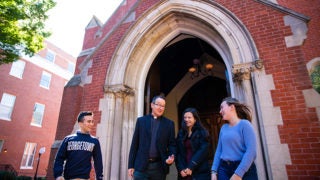
Ignatian values are woven into the university’s academics as well, from Georgetown’s core curriculum to Ignatian seminars for first-year students, said Fr. Mark Bosco, S.J., vice president for Mission & Ministry at Georgetown. These values – discernment, contemplation in action, or marrying reflection with action – can be particularly foundational for leadership, he said.
“Georgetown encourages students to reflect these values through our core curriculum, those humanistic courses in theology, philosophy, history and literature. Having this broad sense of the humanities positions Georgetown students to understand the magis, the deeper and most meaningful way to know yourself and to help others live meaningful and just lives,” he said.
“Students see these values lived out and it impacts their choices, fostering leaders who act with the wisdom and purpose formed during their time here on campus.”
Over in the McDonough School of Business, Fr. Quentin Dupont, S.J., teaches undergraduates and graduate students about ethical leadership in business. Helping students cultivate Ignatian practices, including being a person for others, can make them impactful, humble and purpose-driven leaders, he said.
“When we’re able to effectively help our students understand [Ignatian values], I think that makes them qualitatively better prepared for leadership and therefore better leaders,” he said. “While they’re in the hubbub of the day, they’re still aware of this deeper calling to make the world a better place.”

A New Chapter at Georgetown
As Peñalver closed out his retreat in Gloucester, deeper insights emerged.
He wouldn’t be alone in his new role: He’d be working in a collaborative environment grounded in a 500-year-old tradition. And he contemplated Georgetown’s role and mission – and how it could be responsive to the world now, grounded in this Jesuit tradition.
“There are other great research universities, but none that bring to those questions the Jesuit and Catholic character that Georgetown does,” he said. “The human values that come out of that tradition are responsive to the challenges that we’re facing as a democracy, as a society and as a global community. Georgetown speaks directly to that.”

The retreat is part of a regular set of spiritual practices that Peñalver attends to, he said. And as he begins his role as the 49th president of Georgetown, he carries with him these Jesuit values that he shares with the community.
“What I hope will guide me is an authentic understanding of Georgetown and its values and its aspirations, and that’s part of my learning,” he said. “Whatever I do in this job, I want it to be true to this community,” he said.
“There’s a set of shared values that all Jesuit institutions participate in, but each one has its own way of living that out. Georgetown has its own way of being Jesuit, and my hope is that whatever I’m doing, I’m faithful to that.”
Editor’s Note: The first photo in the story is by Elman Studio.