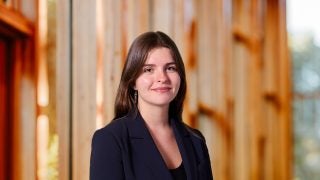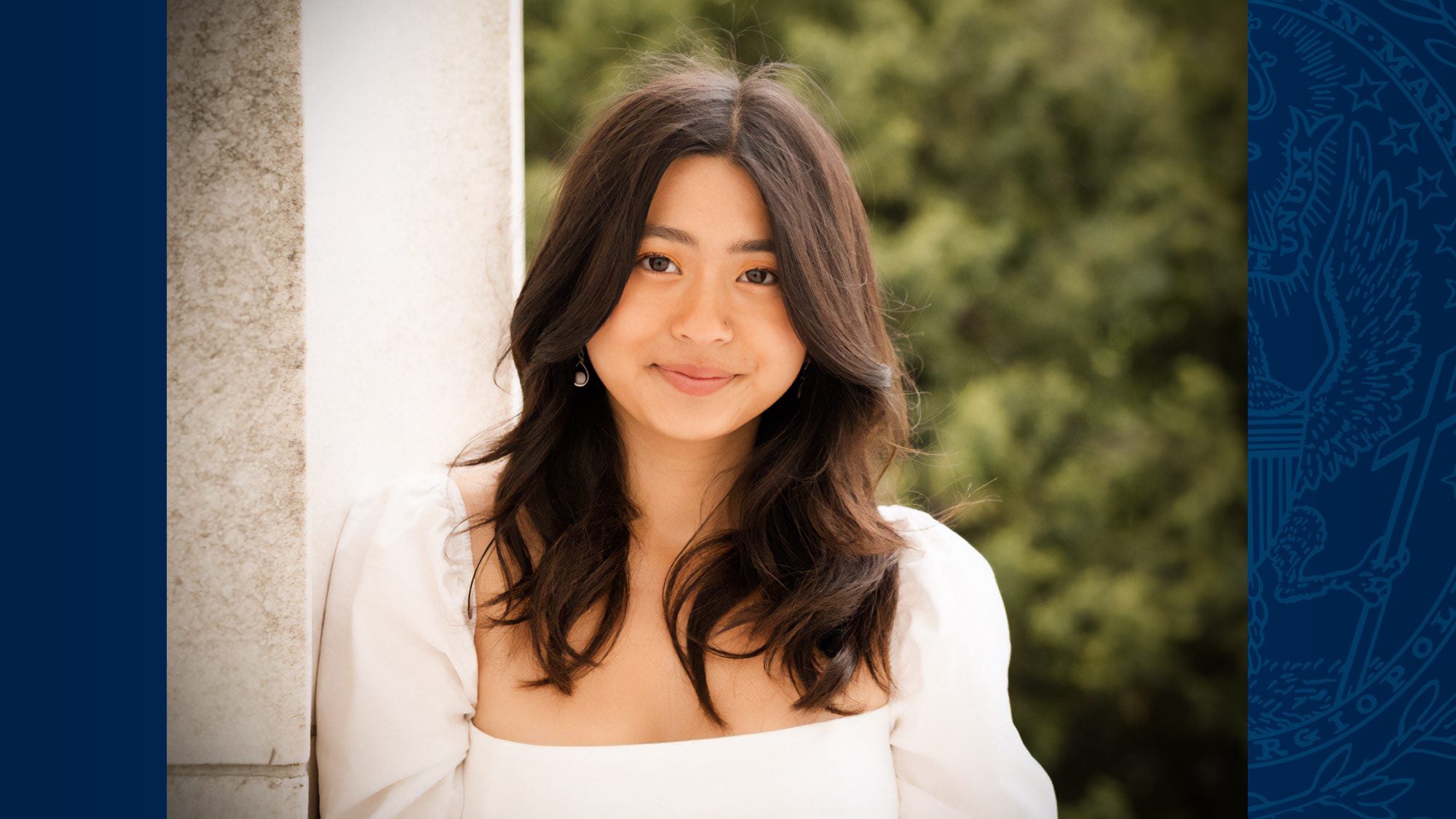
Anya Wahal (SFS’23) has been named a 2026 Knight-Hennessy Scholar, a prestigious graduate program at Stanford University that prepares students for international leadership.
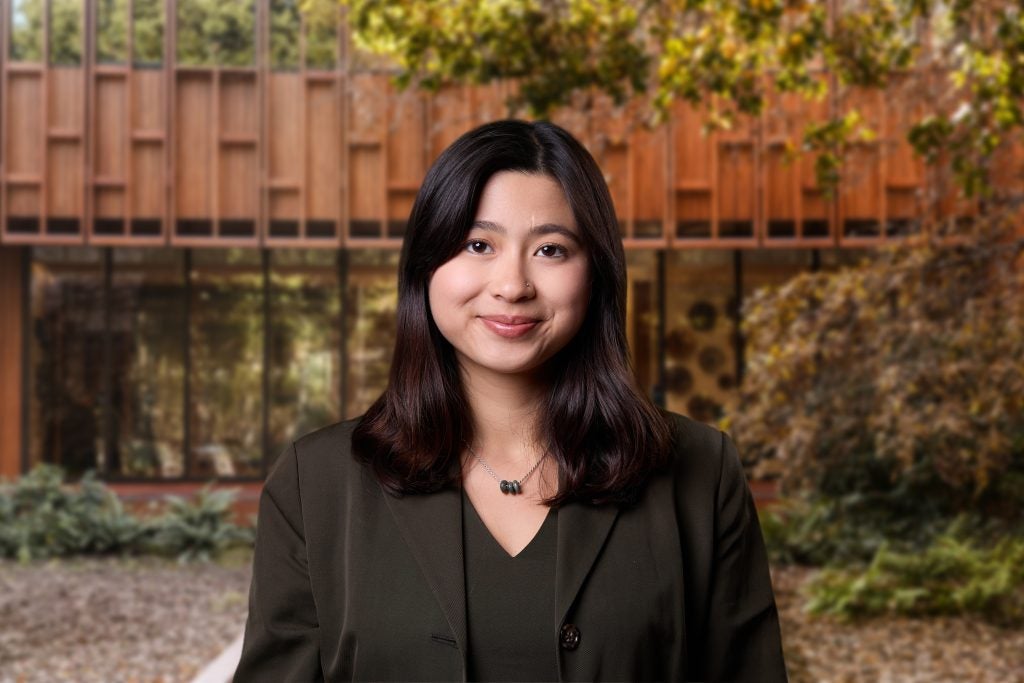
Wahal is one of 87 scholars from 31 countries in this year’s cohort. Scholars receive up to three years of financial support for graduate school while taking part in mentorship, experiential learning opportunities and leadership development to prepare them for future leadership roles.
Wahal joins five other Hoyas who have been named Knight-Hennessy Scholars in recent years, including last year’s recipient Elena Sapelyuk (SFS’23). At Stanford, Wahal will pursue a juris doctor and Ph.D. in water policy.
“We are proud of Anya and her work, from here at Georgetown to her time as a Fulbright Scholar and Marshall Scholar and now as part of the next cohort of the Knight-Hennessy Scholarship,” said Lauren Tuckley, director for the Center of Research & Fellowships. “Her research demonstrates the rigor and passion needed to make a change for the common good in water policy.”
Ever since her first year at Georgetown, Wahal has dedicated her research to water policy and how it impacts people, particularly in vulnerable communities with limited access to water. Now as a Knight-Hennessy Scholar, she will continue her work to bridge the divide between policymakers and the people they serve.
“Stanford is the single best place to study water in the U.S. I never really thought this was in the cards for me,” she said. “I just gave it my best shot, and the universe aligned for me. I don’t know how it happened, but I feel enormously grateful to be doing all of this.”
Building an Expertise in Water Policy
Growing up surrounded by nature in Scottsdale, Arizona, Wahal understood the importance and scarcity of water. She practiced water conservation from an early age, such as turning off the faucet while brushing her teeth and running only full loads of laundry or dishes.
Wahal came to Georgetown with a wide range of interests and was unsure of what to do in her career. She was first introduced to water policy and issues in the class Water with Professor Mark Giordano in the School of Foreign Service. When she realized how water touches every aspect of society, she was hooked.
“Water is the foundation for every civilization,” she said. “When I realized water is just a mechanism for studying everything, that was a big sell for me because it impacts the economy, it impacts policy, and it impacts science.”
She credits Giordano and other mentors at Georgetown for guiding her through her academic and professional journey. She said the easy access she had to Georgetown faculty and staff to discuss ideas and build relationships empowered her to pursue her research interests.
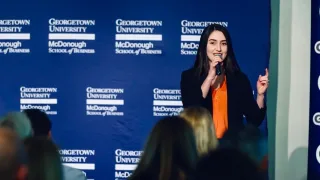
As part of the Mortara Center for International Studies’ Undergraduate Research Fellowship, Wahal continued to research water issues with Giordano, even presenting at conferences around the world like in Singapore.
“After Anya presented our work on the Brahmaputra River in Singapore, some of the conference attendees asked if she was a Ph.D. student or a post-doc,” Giordano said. “They were surprised when I told them she was an undergrad.”
For her undergraduate thesis, Wahal conducted an ethnography, interviewing policymakers and farmers in Arizona to understand the disconnect between water policy and farmers’ personal experiences with droughts.
After graduating from Georgetown, Wahal received a Fulbright Scholarship to research water equity and access in India. In Delhi, she met with people living in informal settlements, which are typically not connected to any official water utilities, to understand their experiences with water and how it relates to government policy.
Her time in India taught her how different identities can influence how people experience water policy in their lives, a lesson she now considers in her current and future research.
“There’s intersectionality in America, but in India, there are just so many more layers. There’s caste, what migrant community you come from, what languages you speak, what kind of jobs you have, what gender you have. It was just so much more that I needed to consider in terms of water equity in my work.”
After completing her Fulbright, Wahal received the Marshall Scholarship and has pursued a master’s degree in water science policy and management at Oxford University, from which she will graduate in June.
At Oxford, Wahal built on her undergraduate thesis and researched the relationship between water policy and Taiwan Semiconductor Manufacturing Corporation (TSMC), the world’s largest semiconductor foundry, which has manufacturing plants in Arizona.
“Semiconductor manufacturing is hugely water-intensive, so I was intrigued by this relationship, especially because Arizona has such little water to give,” Wahal said. “TSMC is generally focused on water efficiency and water technology advancement. At the same time, consumption has skyrocketed, which means that at some point the situation becomes untenable, and expansion and policy need to reflect that.”
A Future in Policy Leadership
Over the course of her research, Wahal has always come back to identifying the gaps between water policy and how everyday people experience water.
Wahal said that earning a law degree along with a Ph.D. will allow her to more effectively bridge the gap between people and policy while also being a part of the scientific community.
“That community-based research offers a human level that data can’t provide. When you add the two together, it offers a completely new perspective on policy,” she said. “As a lawyer and researcher, I’ll be able to identify those disconnects and maybe help do something about it.”
Wahal hopes her time at Stanford will lead her to a career in public interest work around water policy. She said she’s eager to be surrounded by other Knight-Hennessy Scholars studying different disciplines who can shed new perspectives on her water policy research and legal studies.
“Doing work that you truly love and care about and want to do every day is an enormous privilege and something that I don’t take for granted,” she said. “I feel like all my dreams have come true and that I’m meant to do this work.”