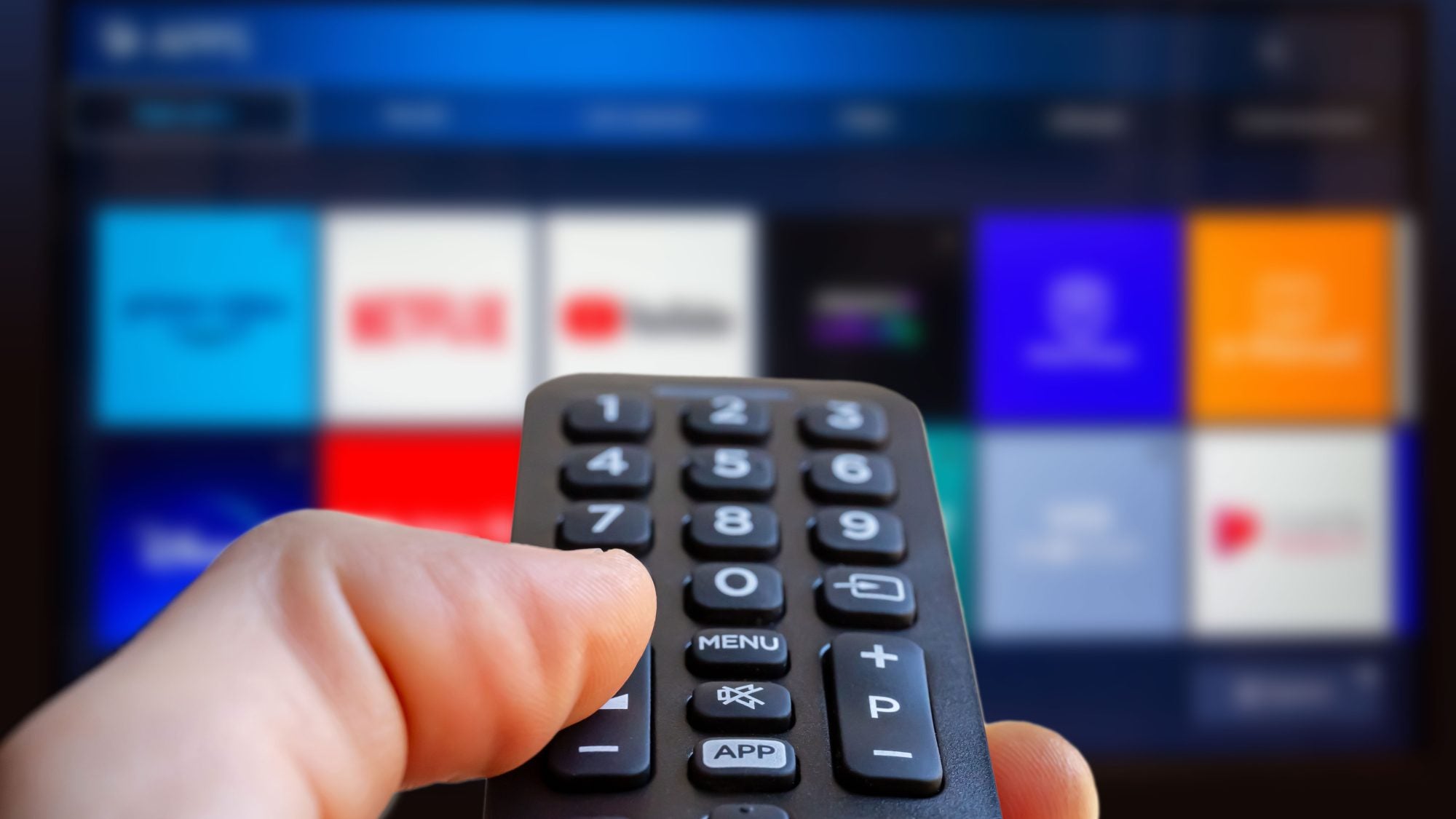
A man is holding a remote control of a smart TV in his hand. In the background you can see the television screen with streaming entertainment apps for video on demand
Category: Discovery & Impact

Title: Divider or Unifier? How Television Shapes Culture and Society

When you turn on your television, what you’re watching probably isn’t what’s on the screens of your neighbors, coworkers or even your friends and family.

But that wasn’t always the case in the 100 years since television was invented. When televisions became widely available to the U.S. mass market after World War II, Americans largely watched the same content. 

That’s because there were few networks and television channels to choose from, said Caetlin Benson-Allott, an English professor and the director of Film and Media Studies in the College of Arts & Sciences. Because early TV audiences consumed the same shows, they participated in a shared national culture and conversation, she explains. 

“You might’ve hated ‘The Brady Bunch’ in the ‘60s and ‘70s, but it was there. You knew what it was, even if it wasn’t appealing to you,” she said.

Today, the sheer volume of shows, movies, streaming outlets and channels means that people are more likely to only watch content that feeds their specific interests and world views.

“It’s hard to get a national conversation going around a television show in an era of nichecasting as opposed to broadcasting,” Benson-Allott said.

We asked Benson-Allott about how television has evolved over its 100-year history and how it continues to shape society today, especially when we’re all watching something different.

Ask a Professor: The Impact of TV on Culture

When we look at the history of television and media, how would you describe the historic role of television in society?

TV was always understood as a social technology, but it was not necessarily a domestic technology at first. There were ideas of it being in movie theaters or bars, but the concept was always to bring the world to you. 

And what impact has it had on our society? I think it’s crucial to the very idea of globalization, of creating a global culture. You can see examples of that in history. The Vietnam War was the first war televised in the U.S. A lot of historians say that the anti-war movement arose in part from Americans seeing real on-the-ground violence happening on their living room television sets as they were eating dinner. People weren’t prepared for that, and it really changed the way we thought about armed conflict.

How else has television changed our culture?

In the U.S., the sitcom was one of the huge shifts that solidified television as a family domestic technology. Sitcoms came to television in the late 1940s and early 1950s as part of the post-war TV culture boom. What they did was help people laugh at but also make sense of the crazy new world that many folks were living in: this bizarre, new widespread phenomenon called the suburbs. Sitcoms helped normalize living away from your family of origin and instructed viewers on how to get along with these weird, kooky neighbors they never picked and had nothing in common with. 

The sitcom was part of the popularization of television, but television was also part of the popularization of suburbia. You really couldn’t have either without the other.

As cable and media networks expanded, did the type of content people watch also change?

Coming out of World War II, most U.S households only had access to one or two television stations. If you lived in Los Angeles or New York, you might have three. Cable started to spread out over the 1960s, but when cable went digital in the 1990s, it allowed for a huge boom in creating content for specific audiences. That’s when you get HGTV or Logo TV for queer audiences. Black Entertainment Network was an early innovator in this space. 

With digital cable, we started to get “niche TV” instead of broadcast shows designed to appeal to – or at least not offend – as many viewers as possible. With niche TV, you get TV that’s aimed at you or your demographic specifically, and that starts atomizing us. In the ‘90s, we used to have this concept of water-cooler television like “Seinfeld.” It was must-see TV because everybody’s going to be watching it and talking about it in the office tomorrow. But by the late ‘90s, water-cooler television was going the way of the dodo. Niche TV was like a precursor to the echo chambers of social media.

Old style TV with Ask a Professor branding

Isn’t the diversity of content from more television networks a positive development?

Yes, because 1950s and ‘60s television was extremely exclusionary. Racial representation was typically stereotyped. You rarely saw working-class families on TV until the 1970s. Diversity is important, but it’s also important to note that it was by approaching diversity as atomization that we lost this national conversation. When we started listening to more voices, the audience split up. It didn’t have to be that way.

We’ve seen in the last 15 years an inability of Americans to talk to each other across political differences. We are largely only interested in talking to people who already agree with us. One of the benefits that national newspapers, television networks and films can offer is that they bring us all into focus on the same issue at the same time. 

You can think about the Civil Rights Movement and the representation on national network news of anti-Black police violence on nonviolent protestors. Whether you lived in the South, Boston, the Great Plains or Seattle, this was a national conversation, and we were all drawing on the same three or four sources to get our information.

Now, people are choosing news networks that reflect their ideological positioning, and we can’t even agree on what the truth is.

People often watch content on their phones and social media. How has modern technology changed our relationship with television?

The media critic Richard Grusin said that the content of all media is older media. When I’m on social media, I see clips from classic series, reality TV and news networks. These clips have been produced for the internet, but it was a television network that provided the talent and made the material available to us. We make memes from television series. Television is coming to us differently, but it’s still a vital part of our conversation. 

How has streaming changed television’s cultural impact and our daily media consumption?

For decades, media fans and tech writers dreamed of having what academics used to call the celestial jukebox, one source from which you could download anything you wanted to watch, listen to or read.

Streaming is always pretending to be that thing without ever living up to the dream. To organize a library of thousands of titles and make it meaningful to people, you have to curate. Today we use algorithms instead of turning to the staff-pick shelf at a local video store. This algorithmic media culture, which began when Netflix started streaming in 2007, is how we consume news, politics and entertainment and how we relate to each other as human beings these days. We go from what we like to what we like without pushing ourselves or seeking out challenges to our point of view.

It’s this kind of cynical, give-the-people-what-they-want-so-you-own-their-eyeballs that I think gaslights us into being a little less critical about what we’re told we’re going to like and makes us less curious about what we’re not seeing. 

How does the consolidation of media conglomerates shape television culture and modern society?

Most of the media you watch comes from massive corporations. The Paramount deal is reminding us that where we see diversity today might be diversity in terms of political perspective or demographic categories, but it’s not diversity in terms of who’s greenlighting these shows and conversations.

It might feel like there are more cable channels than ever before, but in some ways, there are also fewer opportunities to bring your idea to viewers because that’s what consolidation does. It’s there to save money with synergy and cross-promotion instead of creating more jobs for more people, which would cost the corporations more.

How has globalization shaped the role of television in society? Does a widespread, hit global show promote a unified global culture?

There are definitely shows that circulate globally that create a kind of global culture. You can think of the franchising of certain reality series like “Survivor” or “Love Is Blind” that have all these national iterations in different countries.

But there’s also something magical about how much television production remains local. If you expand your search, you will see approaches to television that feel radically different. There’s a lot that has been globalized, but there’s still room for national eccentricity or idiosyncrasy, which I think is important and something we need to hold on to because the push will continue toward globalization.

What trends in digital entertainment and television are you tracking?

I’m interested in how podcasts are becoming television. It’s this interesting movement toward something that was a phenomenon in the 1950s originally, what you might call background television. I could be listening to these people through my earbuds while I’m cooking or folding laundry, but instead being just voices now I can glance at their faces on my laptop as well. 

One of my current research areas is escapism. One of the most popular forms of escapism today is watching older television series, where all the action is just around a few people hanging out and talking in a room.

There are a lot of studies that say we’re in an epidemic of loneliness, and people are struggling to make in-person, real-time human connections. Television, since its origins, has been trying to feel like your family, trying to feel like these friends you see once a week. That’s what has been driving podcasts to make that shift because it keeps you loyal to those series.

What are you watching on TV right now?

I am watching “The Pitt” right now because of its incredible cliffhangers. I can’t watch it on a weekly schedule. I have to be behind, so I stop in the middle of episodes because I can’t deal with the idea of appointment television and waiting anymore. I’m also a huge “Below Deck” fan. I edited a special collection of essays for “Television & New Media” on “Below Deck,” so I could talk about that until we’re both blue in the face!