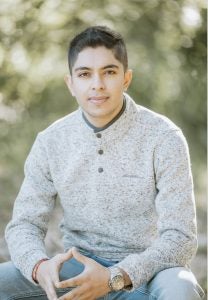
Ishaan Sharma (H’27), a junior in the School of Health, has been named a 2026 Goldwater Scholar, a prestigious undergraduate scholarship awarded to the next generation of scientists, researchers and engineers.
The national scholarship recognizes sophomores and juniors in science, technology, engineering and math. Sharma, a junior who researches neurodegenerative diseases, was selected out of a pool of 1,485 nominees and joins a cohort of 453 scholars. He is the 51st Hoya to be named a Goldwater Scholar.
“The news that Ishaan received a Goldwater Scholarship presents a truly meaningful moment to celebrate his excellent contributions as an undergraduate researcher and his future plans in patient-focused translational research,” said Bill Cessato, deputy director of the Center for Research & Fellowships. “Ishaan’s selection as a scholar also emphasizes the dedication of professors and research mentors who create formative student-centered opportunities for scientific discovery.”
In applying to the scholarship, Sharma was inspired by previous Goldwater Scholars and the possibilities he could pursue in his own career.
“When I looked at past Goldwater Scholars, they were the people running labs, leading clinical trials and pushing science forward. I wanted to take a chance and see if I could do the same,” he said.
Sharma plans to become a physician-scientist studying neuroscience. His path so far, which includes internships and research at the National Institutes of Health, Georgetown, Baylor College of Medicine and Emory University, reflects his drive to research diseases at the molecular level while also understanding the patients behind the data.
A Scholar Driven by Patients’ Stories
Sharma’s interest in bridging research and medicine began in his grandfather’s home clinic in Kashmir, where he worked nearly every summer since fourth grade.
In between sterilizing medical instruments and chatting with patients, Sharma watched his grandfather work. He studied how his grandfather adapted to patients’ needs and complications in real-time and began to think about preventive measures. What could be done to prevent complications before patients reach the clinic?
These questions led him into research.
His first week at Georgetown, Sharma began volunteering and later interning at the National Institutes of Health (NIH). With Dr. Christopher Grunseich, a clinical research scholar, he studied spinal-bulbar muscular atrophy, a rare neurodegenerative disease, and followed patients over multiple years, witnessing both the progression of disease and the emergence of hope through experimental therapies.
He still remembers his first patient visit, a former Ironman triathlete, whose legs suddenly gave out while he was walking at the clinic.
“Watching this once-elite athlete lose something as fundamental as walking transformed the way I saw my work,” said Sharma. “I had spent months studying his data, including information related to his rates of decline, and the experience made the abstract concept of translational research viscerally real.”
For Sharma, the experience revealed the need for clinical researchers who can not only interpret a patient’s data but also understand the human story behind it.
Applying the Classroom to the Lab
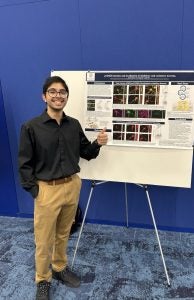
Alongside his research at NIH, Sharma has pursued laboratory work at Georgetown.
At the end of his first semester, he joined the lab of Daniel Pak, a professor of pharmacology and physiology who would become his mentor. There, he has studied strengthening the points of communication between neurons, which are closely tied to memory and diseases like Alzheimer’s.
“Professor Pak has emphasized that we’re in the business of problem-solving, and that’s something I want to be a part of,” said Sharma. “In the lab, you’re really pushed into the details, digging into the mechanisms to understand exactly how and why something works. At the NIH, I’m working directly with patients and their samples. Both perspectives are essential to develop into the physician-scientist I want to become.”
That integrated perspective is rooted in his human science major, which Sharma credits with shaping his approach to research.
“It’s such a unique major,” Sharma said. “You’re not just learning science, you’re learning how to think like a scientist. From the first semester in Dr. Jason Tilan’s Research Theory Class, we were talking about experimental design, how to ask meaningful questions. That’s when I realized, this is what I want to do.”
Sharma’s long-term goal is to pursue an MD/Ph.D. The Goldwater Scholarship, he said, will serve as an entry point into a broader scientific community. As part of the program, Sharma will be assigned a scientific mentor and be invited to attend networking events.
“One of the most exciting parts is the network,” he said. “Being around people who are where you want to be, learning from them, finding mentorship, that’s incredibly valuable.”
In looking ahead to graduate training and a career in academic medicine, Sharma remains grounded in the experiences that first shaped his ambitions: moments at the bedside, questions in the lab and the patients whose stories continue to guide his work.
“This is the perspective I carry forward,” Sharma wrote. “To see a patient’s story not just in their symptoms, but in the science beneath it.”
By Heather Wilpone-Welborn