What does the prefrontal cortex do, and how does the brain use it to learn new tasks?
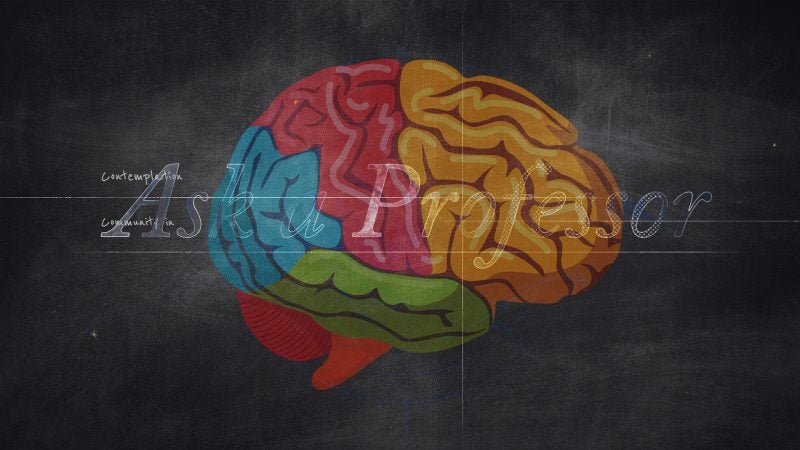
The front of our brain is the so-called prefrontal cortex. It’s the brain area that enables us to reason, control attention and focus and learn new tasks – lots of abilities that are critical to intelligent behavior. In a way, our prefrontal cortex is a big part of why we rule the world, not the monkeys or the worms or whatnot. This prefrontal cortex is what lets us learn complex things very quickly. Now we know this is great at learning, but on the other hand, it can only do one thing at a time. And that’s usually helpful because you want to be locked in; you want to stay on task.
What does the temporal cortex do?
The temporal cortex does a lot of things, but what was most important for us was that it is not only a really important part of our visual system, but that it also is critical to quickly make sense of the world when we look around, allowing us to automatically identify people, cars, trees, houses, etc. without having to engage our prefrontal cortex.
What was not clear was how the temporal cortex learns this ability. We knew from other studies that the prefrontal cortex and temporal cortex “talk to” each other, and we hypothesized that the prefrontal cortex could first learn a new task and then use its connections to the temporal cortex to transfer the learned task to the temporal cortex, thereby freeing it up for other things.
How does moving a task to the temporal cortex help clear the bottleneck in the prefrontal cortex?
We found that after 20 hours of doing the task, people got better at multitasking when we asked them to do the car task plus another task. It’s this task where you show a disk that’s [green and red], and people have to say whether it is green on the left or right side. It’s simple, but it’s been shown that it requires attention, which requires your prefrontal cortex. We had people do the disk task and the car task at the same time.
It turns out that after they’ve done the car task 30,000 times, people could do it better with the disk task. We then did brain imaging to show that the less the prefrontal cortex was engaged and the more temporal cortex directly connected to the motor system, the better people were with dual tasking.
What’s happening in the brain that allows us to multitask?
The visual system is interesting. It starts with your eyes, then it goes through the middle of your brain to the back of your head. Back there, the brain breaks down the world into lines. Your brain uses edges, so the world gets broken up into these lines and puts them together to build up more and more complex representations.
You go from lines to eventually neurons that are selective for faces, words or cars. From there, you get to areas of the brain that create meaning. The face is just a shape, but after meeting you, I’m going to have a neuron that connects your face to our experience of talking.
This is the input that your prefrontal cortex can then use to do tasks. The prefrontal cortex connects to your motor system, which could ultimately move your fingers or your vocal cords to speak. That’s the center where you take all the inputs and decide what to do next.
We already know that the prefrontal cortex gets all these inputs and then decides what to do with them. The key part in our study is the learning — that we learn something in the prefrontal cortex and then send it down to the temporal cortex. We’ve provided evidence that the prefrontal cortex learns it first, but then it trains this other part of your brain so that it can do the task too.
Why is the ability to multitask important? What does your research on multitasking say about human potential and the power of practice?
The encouraging news is that practice really makes you better. If you keep doing something, then the prefrontal cortex can teach another part of your brain to take over. If you stop doing it after you’re good at it, then that second step doesn’t happen. It just stays in the prefrontal cortex, but it doesn’t become automatic. The idea is that if you keep doing it, that’s when you get the practice that then lets your prefrontal cortex teach another part of your brain.
Practice might not make perfect, but it makes it automatic.
Can multitasking ever be harmful for people?
That’s the flip side. When task circuits are in the prefrontal cortex, your so-called cognitive control system in the prefrontal cortex allows us to stay on task and can suppress the task circuits that are irrelevant. But an addict, for instance, has a hard time ignoring drug paraphernalia because the response has been automated; it doesn’t go through the prefrontal cortex.
Once it’s not in the prefrontal cortex but somewhere else, then the automation bites you in the rear because now you can’t consciously suppress it. The question is, how do you unautomate it? That’s something we don’t know yet, the million-dollar question.
Can we really do anything while multitasking? What are the limits of multitasking?
That’s something we’re trying to figure out: What are the limits of this automation? How complex can you get?
The prefrontal cortex can learn all kinds of things. Driving is an amazing example because it is really complex. You have to operate a car, look at the road, respond to it and still we are able to learn it in a way that dramatically reduces when attention is needed – we can often drive home while engaging in conversation, almost like on autopilot, as long as nothing unexpected happens. There might be a lot we can do automatically, but it’s a question of practice.
How does the brain’s multitasking ability compare to what AI can do?
Current AI systems have this base model that you can interact with by prompting it. In a chat session, the model draws on what it has been trained on to predict responses. However, the base model does not change in a chat session, so it cannot learn new things. The base model is a bit like your temporal cortex, representing all the stuff you’ve learned, and the prompt processing is like prefrontal cortex, keeping in mind what has been said so far and then predicting the next word in response.
When it comes to the brain, we show how a prefrontal “chat session” can add to the temporal cortex base model, which allows the brain then to use the refined base model, for instance to make it easier to learn related tasks, which is something we are planning to explore next.
This building on prior learning is one of the capabilities of our brains that AI cannot match well yet. Neuroscience and AI have had a very fruitful symbiotic relationship, with AI providing demonstrations for how the brain could solve computationally hard tasks, and AI systems learning from neuroscience, for instance, how to recognize objects and learn strategies.
This field of so-called neuromorphic AI has provided a lot of breakthroughs in AI. Current large language models show the power of brute-force computing based on a simple idea, that of predicting the next word based on context, but we are starting to see its limitations, for instance, in the persistent problem of hallucinations – something the brain usually does not struggle with because it has different systems for reasoning and for storing facts. As we are seeing with our work on how the brain can automate tasks, it is likely that the still only “generally intelligent” system in the known universe, the human brain, still has a few tricks up its proverbial sleeve that AI systems can benefit from.