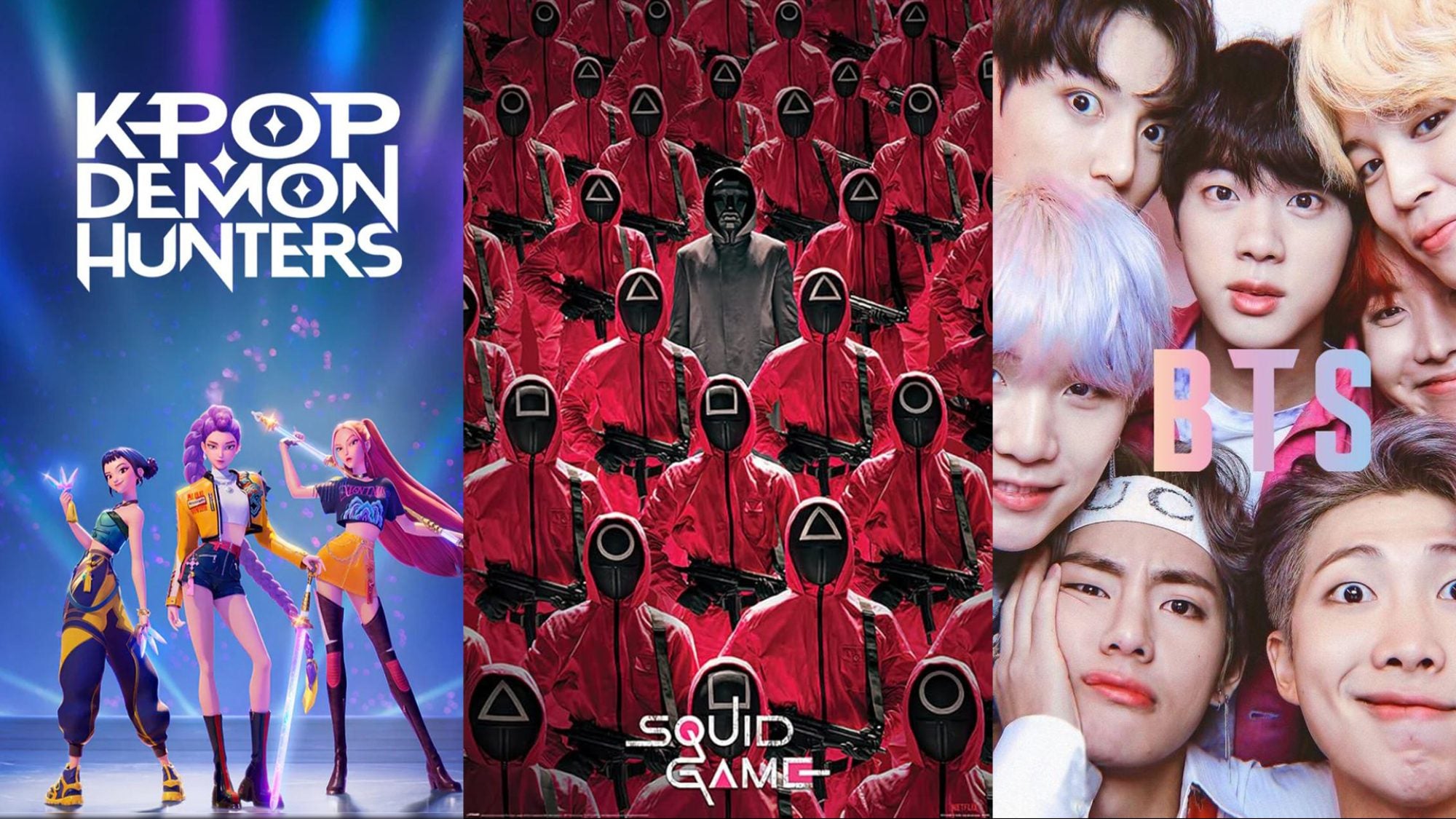
What has enabled Korean culture to take off in the 21st century?
I think webtoons played a major role. Webtoons are episodic digital comics that took shape in the late 1990s and early 2000s, designed for vertical scrolling on screens — especially phones. Their storytelling is natively platform-ready: a few panels, a scroll, a mini cliffhanger — and then you wait for the next episode. Your thumb becomes part of the story’s rhythm. Webtoons are a storyboard for digital life — and a form of popular literature: serial narrative writing and visual storytelling, a reading practice with built-in interpretation and fandom. And because audiences are already invested, webtoons adapt especially well into dramas and films on global streaming platforms.
Some people also note that the pandemic accelerated the global rise of Korean content because it changed viewing habits: more time at home, more streaming and more willingness to try something new. And Korean series and films were right there — already easy to access on platforms like Netflix — and then social media and word-of-mouth did the rest.
How does South Korea’s history shape its ability to export its culture?
After the Korean War, South Korea was extremely poor, and economic development became a national priority. Over time, cultural production became part of that broader project: the state and cultural industries began treating popular culture as an exportable sector that could travel and bring in foreign currency alongside other export strategies.
Another thing worth noting is the postwar infrastructure. Korean performers worked within U.S. military entertainment circuits, which offered steady work, performance training and experience playing to international audiences.
Korean content has resonated strongly in parts of Latin America. Colleagues who study popular culture often describe an “affinity,” especially around late Cold War histories of authoritarian rule, rapid modernization and the uneven social costs of economic growth. When those experiences echo, an 80s-set Korean drama can feel less like distant history and more like a recognizable memory-world, and stories set during war or dictatorship can resonate with local histories of fear, endurance and everyday negotiation.
What role has language played in the export of Korean culture?
Language matters less as a barrier than people assume. We’re in a platform era where audiences are already used to watching across languages. Streaming platforms make language feel like a setting, not a wall, with global distribution and wide language and dubbing options. Trying a show in another language is easy and low-commitment, and before you know it, you’re already three episodes deep.
In such an environment, Korean cultural industries have gotten very good at making stories and formats that survive translation: clear genre signals, high emotional stakes and serial storytelling that practically dares you not to click “next episode.”
In South Korea, English is highly visible compared to neighboring contexts, especially as a stylistic element in branding and interfaces. For viewers with little prior contact with Korea or Asia, that small familiarity can make Korean media feel like a friendly gateway. It’s not that English is required, but Korea’s cultural industry is strongly global-facing and adept at attracting new audiences.
Korean diaspora communities and fandom networks worldwide also amplify this effect: they translate jokes and context, organize watch parties, make memes and recommend what to watch next, so watching becomes a shared, communal experience.
Are there any specific genres of Korean culture that are resonating with foreign audiences right now?
I’m always tempted to predict the next big one, and I’m almost always wrong because global hits love to come out as surprises. Honestly, that unpredictability is part of what makes this moment so fun to watch. It is also a good reminder that what travels isn’t one “K-genre.” It’s the combination of a clear genre entry point and a strong emotional hook, something that can click with very different audiences fast.
In what ways have you seen Korean culture influence Western cultural products?
It’s more helpful to think about this in terms of circulation — through platforms, markets, and communities, rather than relying on an East/West binary framework.
“K-beauty” is a good example to see this. K-beauty didn’t just travel as products; it traveled as routines: skin-first prep, cushion foundations, gradient lips, softer eyeliner or different contouring styles. You pick it on platforms through tutorials and GRWM videos; you see it translated into marketing languages like “glass skin (luminous complexion)” or “aegyo-sal eye (under-eye emphasis)” with new product lines, and then it spreads through everyday social life — friends, group chats, comment sections — saying, “Try this,” “This works,” “Start here.”
Food works in a similar way. Korean food has shifted from “ethnic cuisine” to something a lot of people treat as everyday comfort food. Social media helps people figure out what to order or cook, and neighborhoods like Koreatown have become multi-ethnic hubs — places where Korean food is something people go out for together, not just something you only encounter in a niche corner.
How has the increased popularity of Korean culture affected South Korean society?
What I’ve observed is a mix of pride and pressure. On one level, there’s a strong sense of pride — an awareness of how far it has come since the Korean War and Japanese colonial rule — and a feeling that this kind of global visibility is exciting and well-deserved.
At the same time, I’ve also noticed a quieter anxiety about what success does to an industry. When the spotlight gets this bright, the production logic can shift: bigger budgets, tighter schedules, higher expectations, more stakeholders. And when risk starts to look expensive, projects can drift toward what’s already proven — familiar beats, familiar casting, familiar pacing. The concern you hear is whether you end up with a handful of reliable templates, while the weirder, sharper, less algorithm-friendly storieshave a harder time getting made.
And then there’s the everyday-life side. Ordinary routines from Korean culture and society became someone else’s bucket list. You see little micro-communities forming in everyday spaces — strangers and regulars, longtime fans and curious newcomers, locals and tourists — briefly sharing the same references in real time. It might be a café someone recognizes from a drama, a pop-up event, a concert queue or even a grocery aisle where someone suddenly goes, “Wait — you know that too?”
So I don’t read it as one clean story — it’s pride, pressure and a lot of new forms of everyday contact unfolding at once.
How has the South Korean government supported this mass export of Korean culture?
A lot of it is very practical and infrastructural — funding and the institutions that help culture travel. Institutions like the Literature Translation Institute of Korea (LTI Korea) are one part of that ecosystem on the literature side. And the bigger point is that circulation isn’t just “great writing” or “great content” — it’s the labor, training and relationships that move work from creators to translators to publishers, platforms and audiences.
What are your favorite pieces of Korean media or culture you’d recommend to people?
For a TV show, I often recommend My Liberation Notes. It captures Seoul-area satellite-city life — the commute, the family obligations, the feeling that your life is always being spent somewhere else — and that very modern longing to feel more alive.
If you enjoy horror films, I highly recommend A Tale of Two Sisters. It’s not just scary — it’s literary horror working through memory and trauma. I’d actually suggest reading the original tale, Changhwa Hongnyŏn-jŏn, first and then watching the film. It’s a great way to see what is preserved and what is reshaped.
If you’re in the mood for a film that feels breezy but socially sharp, try Microhabitat. It starts light and playful, then gently asks what makes a life ‘livable’ when so much of what comes with “adulthood” feels unsustainable. For a charming follow-up, watch Zion.T’s “SNOW (눈)” music video. Set some time after Microhabitat, the intertextual links — casting choices and visual echoes — invites you to see how the story gets reimagined, translated into a different medium.
And honestly, that’s also how my courses at Georgetown are structured. We start with close readings of films and literary works — how they stage history and memory, and how stories do their work beneath the plot. Then we zoom out to the wider ecosystem — literature, film, drama, music, platforms, fandom — to see how culture circulates, how value gets made and why it resonates so powerfully. If any of that sparks your curiosity, you’d probably enjoy the conversation.