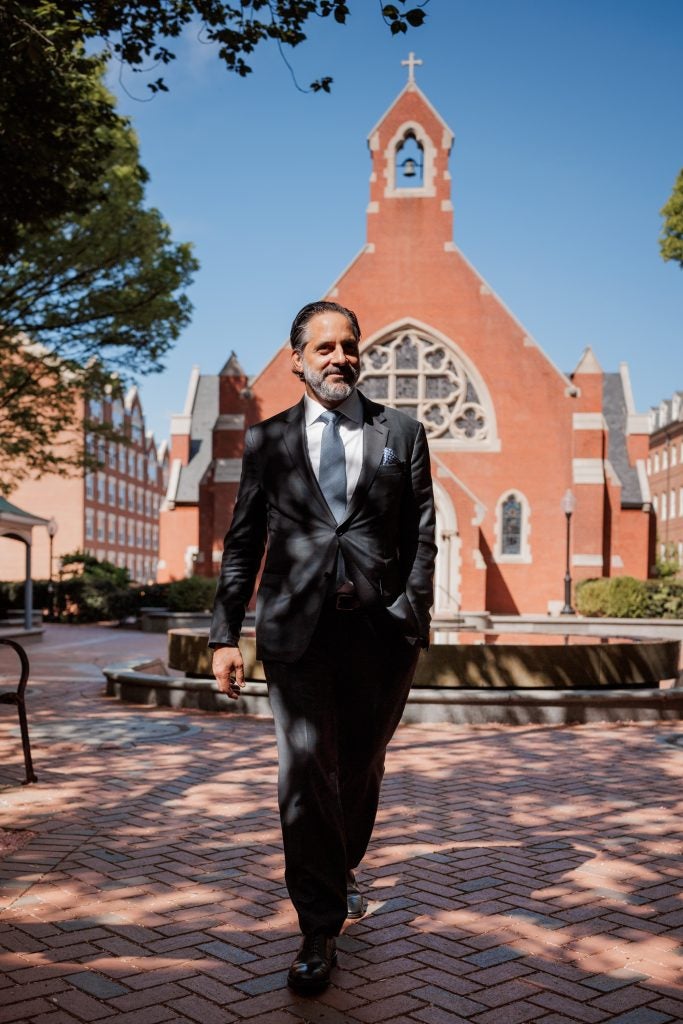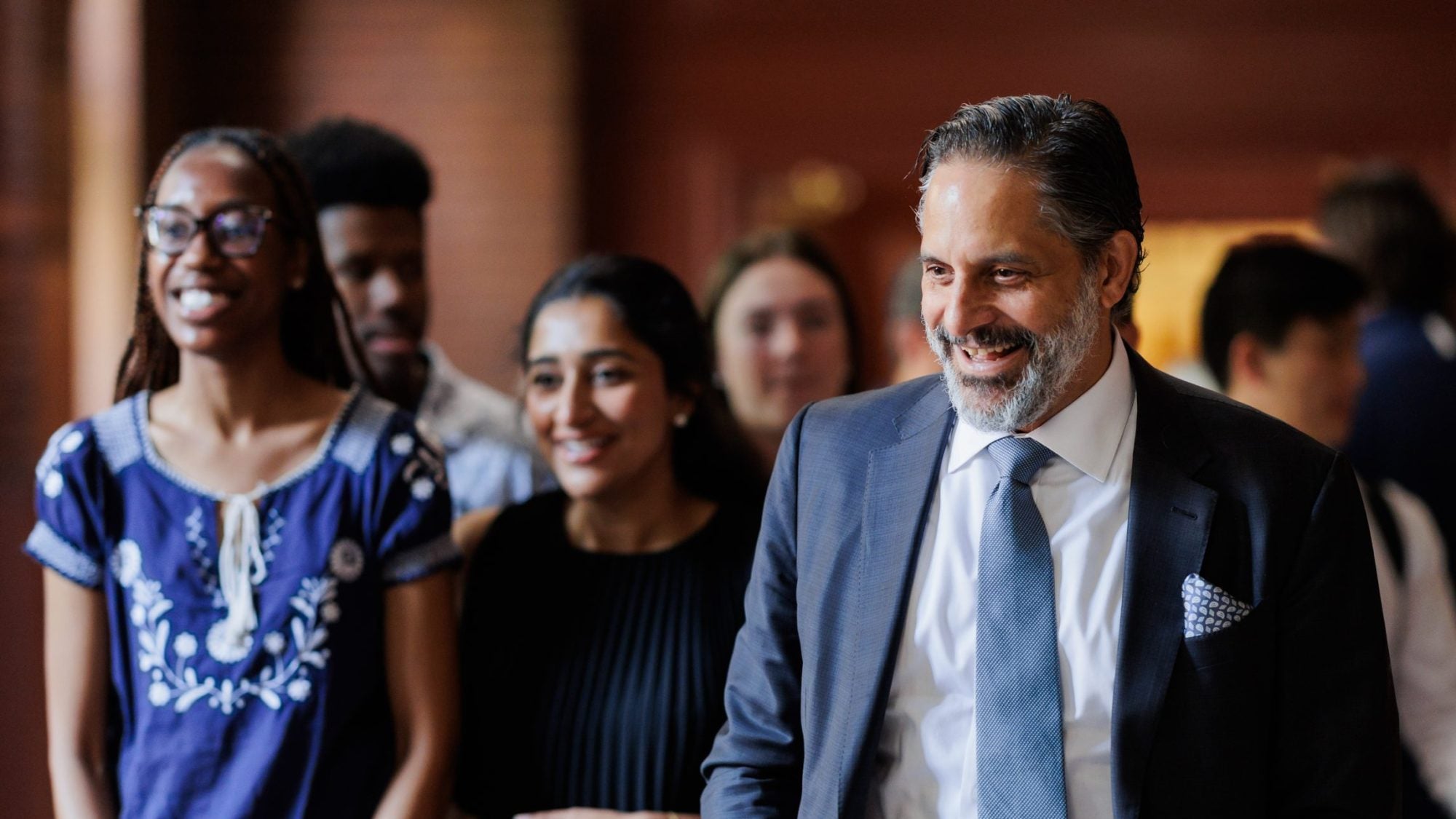
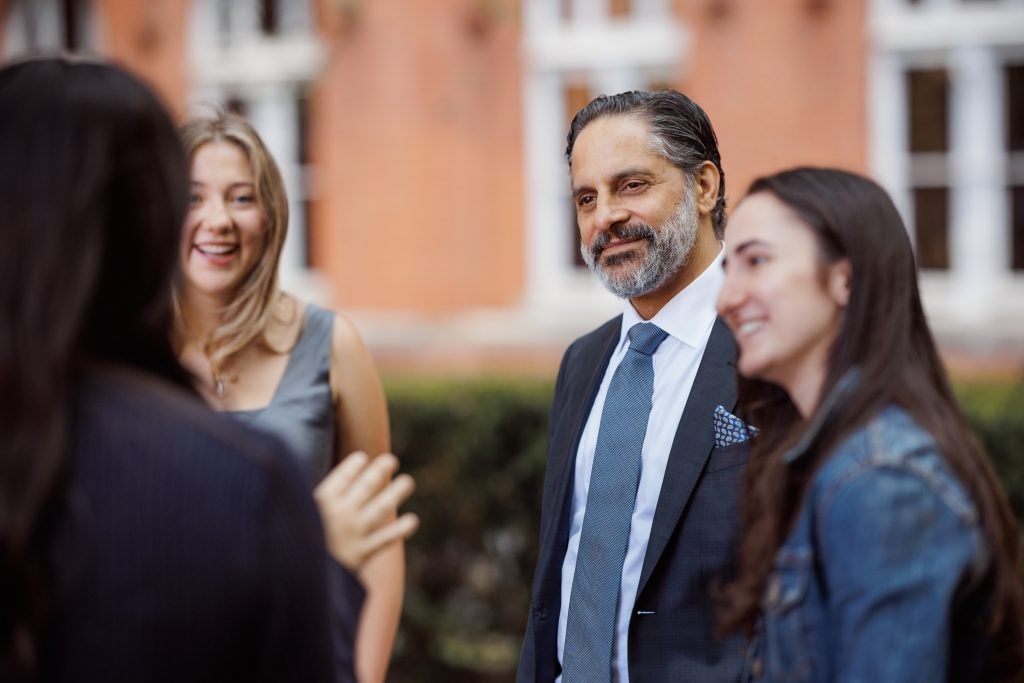
On a bright spring day, President-elect Eduardo Peñalver walks through Dahlgren Quad.
“Welcome to Georgetown!” a group of seniors calls out to him.
It’s 74 days before Peñalver will become the next president of Georgetown University. He’s spending the day meeting with students, faculty and staff in preparation. Hoya-themed socks peek out of his dress shoes.
“These moments of beginning are really exciting,” he said.
“I’m new to this community, and I already am meeting all kinds of new and amazing people who are steeped in the Georgetown tradition. I’m excited to immerse myself in that, learn more, and get to know the community and become a part of that tradition as well.”
For the past five years, Peñalver served as the president of Seattle University — the first layperson to lead the 135-year-old Jesuit institution in Washington.
Jesuit universities share a “family resemblance,” he says, and he brings this commitment to the Jesuit educational tradition and care for the whole person to Georgetown.
“We share this higher aspiration to do more than teach a skill or impart knowledge, but to really get students to grapple with deeper questions, to pursue more ambitious goals like wisdom and understanding and meaning, not just in their academic work but in their lives,” he said of Jesuit universities. “So there feels like great continuity coming from Seattle University to Georgetown and continuing that work in a very different setting.”
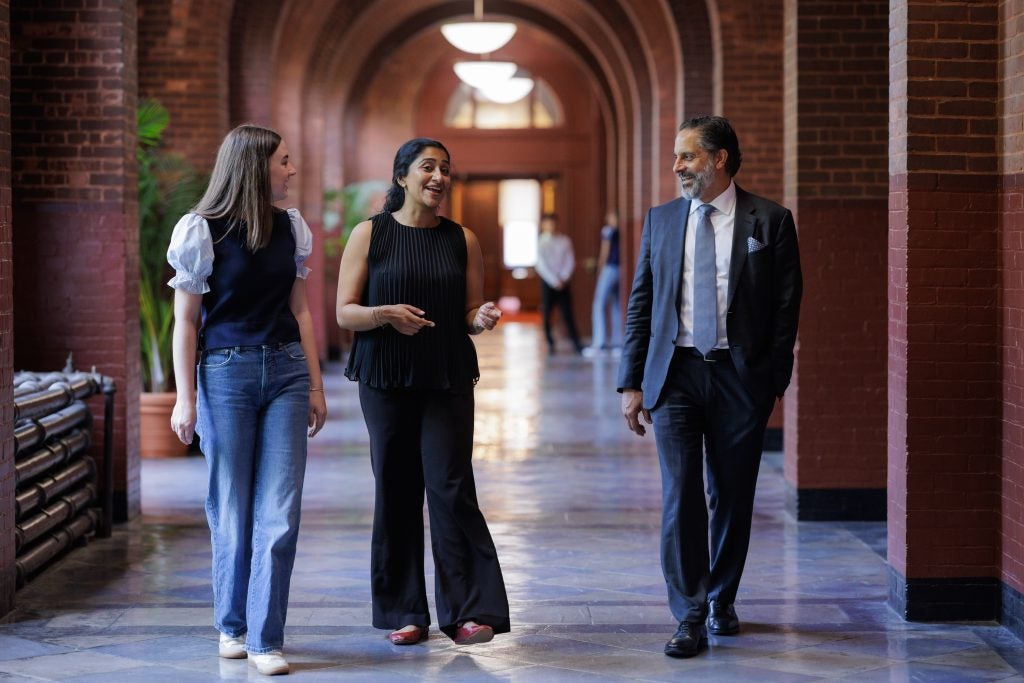
As he prepares for his new role at Georgetown, Peñalver is focused on meeting with community members, advancing Georgetown’s Jesuit tradition of education in the wake of challenges in higher education, leveraging the strengths of the university’s downtown Washington, DC, campus and experiential learning opportunities, and responding to the challenges and opportunities AI creates.
Peñalver is also looking forward to returning to the city where he first began his career, clerking for U.S. Supreme Court Justice John Paul Stevens and working at a law firm.
We sat down with the president-elect to learn about his journey from busboy to dean of Cornell Law School, his preparations for his new role, and how his Catholic faith influences his work.
What drew you to Georgetown?
Georgetown’s a unique institution: being an R1 research university but also very much in the Catholic, Jesuit tradition. You see this in the mission statement when it describes Georgetown as a student-centered research university — that is unique.
I’ve spent most of my career at research universities. The tension between research and teaching has always been one of the challenges that research universities grapple with. So I was really drawn and taken by that aspiration to be a research university but also student-centered and to deliver an amazing student experience rooted in the Jesuit commitment to cura personalis.
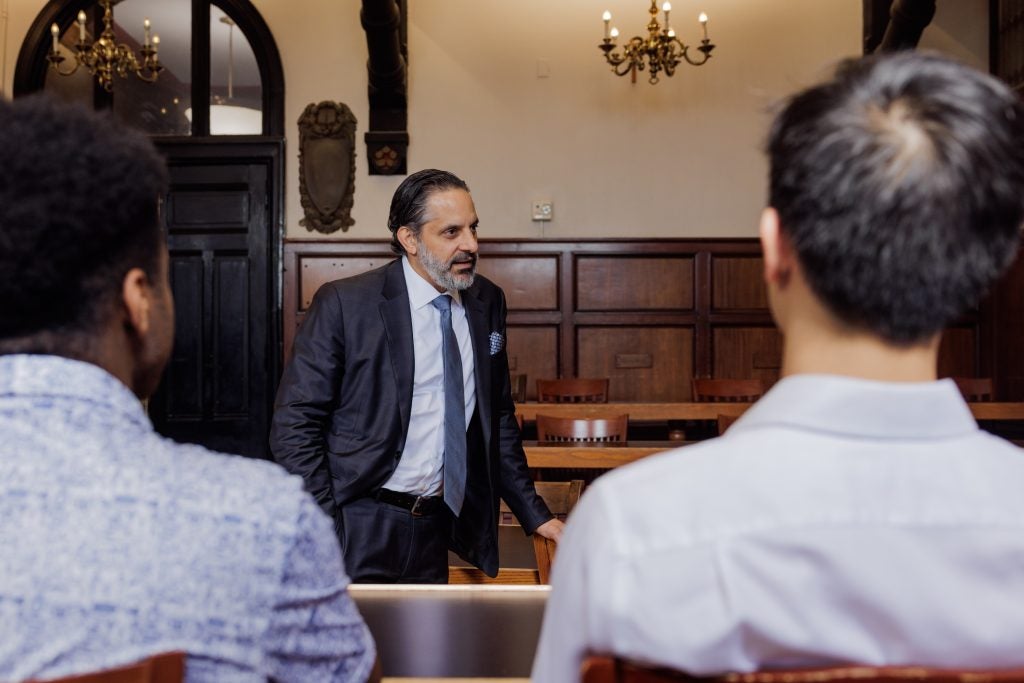
How has the intersection between research and teaching played out in your career?
When I started my academic career at Fordham, I expected to really enjoy the research part of the work. I love writing; that was the initial draw for me of becoming a legal academic, to have the time and the freedom to write about the things I wanted to write about.
And then I quickly learned how much I loved teaching and how much I enjoyed interacting with students. I got some of my best ideas for articles from questions that a student would ask in class. Students are free thinkers when it comes to the subjects that we’re teaching them; they’re approaching the issues with fresh eyes. So I just found a great interaction between my teaching and my research.
How does your Catholic faith influence your work?
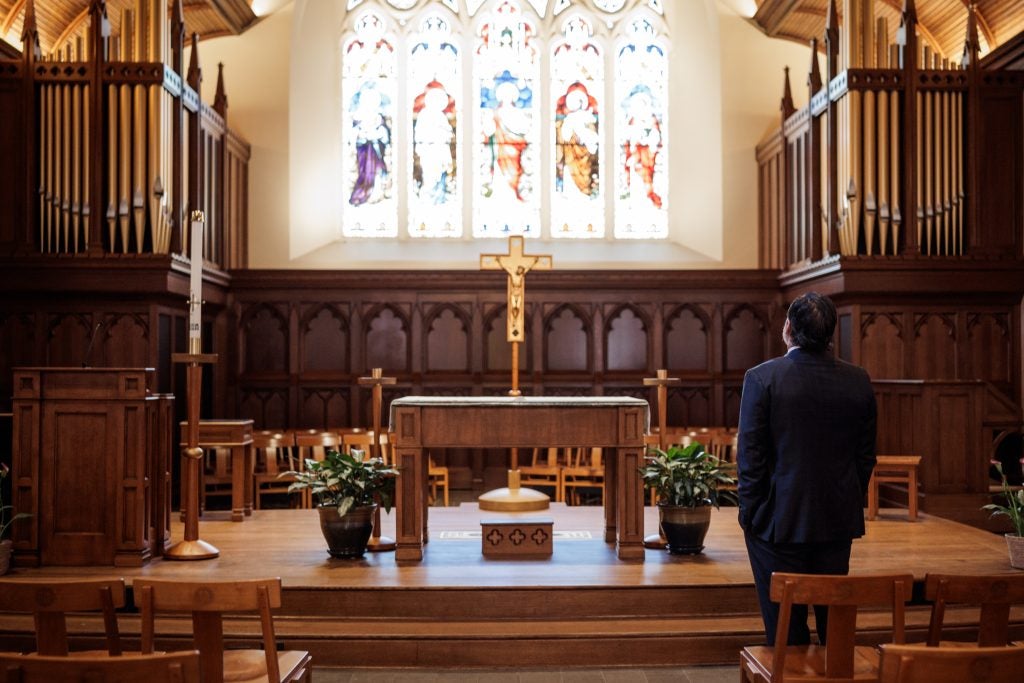
I find that my faith is a source of comfort to me in a pretty challenging job at a challenging time for higher education. There’s a great comfort that comes from the length of that tradition and continuity of that tradition, and knowing all the challenging times that the Catholic Church has seen and lived through. And then there are the truths of the tradition, the truths of our faith — about what it means to be human — that help me think through some of the unusual situations that I have to confront as a university president.
What would you like the community to know about you?
I’m someone who is always learning, and I’m always trying to update what I think. My best thinking is going to be informed by the feedback I get. So I want people to know that I’m always open to that feedback. I view the work of leadership as an extended dialogue that needs to be active on both sides.
At Jesuit institutions, we talk about being contemplatives in action, and both pieces are important. Because we can get kind of lost in contemplation and never take action, or we can just act without thinking. And we need to be doing both at the same time. I’ve always found that the Jesuit tradition really speaks to me in its pragmatism, its orientation towards action but also its reflectiveness and the way it brings those two sides together.
What’s on your mind as you enter this role?
As I prepare to take on this new role, I am spending a lot of time in conversation with members of the Georgetown community and thinking about how we can rise to meet this moment, leading the way with answers that are true to Georgetown’s distinctive history and values.
This is a pivotal time both for higher education generally and for Georgetown. Georgetown is uniquely positioned to offer a distinctive response to the challenges that confront us. The Jesuit model of higher education offers compelling answers to many current critiques of higher education, with its emphasis on intellectual openness and dialogue across our differences and in the way it places students at the center of our educational mission.
Additionally, the rise of generative artificial intelligence is forcing universities to re-evaluate how we prepare our students for the world they will enter and lead after graduation. Jesuits have embraced new technologies for centuries even while it yokes them to ethical limits and human values. Armed with these tools, Georgetown is up to the task of helping our students to navigate the new things being ushered in by AI. Finally, taking full advantage of our Capitol Campus will enable us to provide immersive experiential learning opportunities for our students and to engage with the many governmental, nonprofit and business leaders at work in our nation’s capital.
Washington, DC, is where you and your wife both began your careers. How do you feel about moving back and what are you looking forward to?
It is a full-circle moment. My wife wasn’t expecting to move back to DC, but she’s very excited to be back where we started our careers. DC has totally transformed as a city from where it was 20 years ago.
We’re looking forward to reconnecting with DC. I’m a food person, and DC is a great food town. I think there are still some restaurants that are around from when we were there. We used to go to Kramer’s for brunch, and we loved going to Sushi Taro, both of which are still there. But we’re looking forward to discovering what’s new since we left.
What was your first job before you became a lawyer? What did it teach you?
My first job was as a busboy at a Mexican restaurant in Puyallup called Mazatlan. It was a great learning experience. Being a busboy, everyone assumed I was Mexican or I couldn’t speak English. I’m Cuban. When people put you in that “busboy” category, you sort of disappear to them. You’re not their waiter. You’re not bringing them food. You’re just clearing the table in between meals. So it’s interesting to be in that role and experience the way people treat people they view as “invisible.”
You learn a lot about the important work that’s done under the radar. The restaurant stops working if the busboy doesn’t show up. Tables don’t get cleared. Tables don’t get set. Water doesn’t get put on the table. It’s not a sexy role, but it’s an important role. I’ve always thought, as a leader, it’s important to treat people in those roles with respect.
Is there any leadership advice you’ve received that’s stuck with you over the years?
When I became a dean [of Cornell Law School], one of the first people I called was the judge I clerked for, Guido Calabresi. He’s a judge on the Second Circuit, but for many years was the dean at Yale Law School. He gave me this great metaphor for leadership. He said, ‘The dean is a butler.’ What he meant by that wasn’t self-effacing, because the butler is an important person. But leadership is a service role, and we’re here to make things go better for everyone else. So it’s not unlike being a busboy, too, but different.
What do you do in your free time to decompress?
I love to cook. I try to cook dinner a few times a week, and I find that very meditative. I love feeding people. I used to love making my sons breakfast before I left for work. My wife will complain because it’ll be 10 in the morning, and I’ll start sending her texts like, ‘What are we gonna do for dinner?’ That’s a daily ritual for me.
Tell us about your passion for aviation and flying.
I have been fascinated with aviation since I was 4 years old. My parents took me to the Science Center in Seattle, and there was this model of a Gemini space capsule. I would go in there and flip the switches. Aviation just captured my imagination from that age.
I always promised myself I would get my pilot’s license, and so I did. After my clerkship in DC, I started work at a law firm, and we got this nice bonus. I used a bunch of it to pay off student loans, and then I took about two months and did flying lessons. I’ve been flying for about 24 years now. That’s my main hobby, which is meditative in a weird way. It’s very hard for me to quiet my mind. Flying forces me to focus on something very different than whatever is bothering me in the day-to-day. So it becomes a kind of meditation for me.
What books are on your nightstand right now?
I’m currently reading Michael Pollan’s new book on consciousness, “A World Appears,” which is fascinating in its own right but also has some important things to say about AI. And, of course, I’m working my way through Professor Curran’s three-volume history of Georgetown. I just finished volume 2.
What are the top 3 experiences on your Georgetown bucket list?
- Celebrating graduating students at my first commencement;
- Going to Mass in Dahlgren Chapel;
- And of course, as a dog lover, I can’t wait to meet Jack the Bulldog.
I’ve also heard about the Chicken Madness from Wisey’s, which sounds intriguing, but I’m not sure that I’d put it on my “bucket list” just yet.
This Q&A was adapted from an article originally published in Georgetown Magazine..