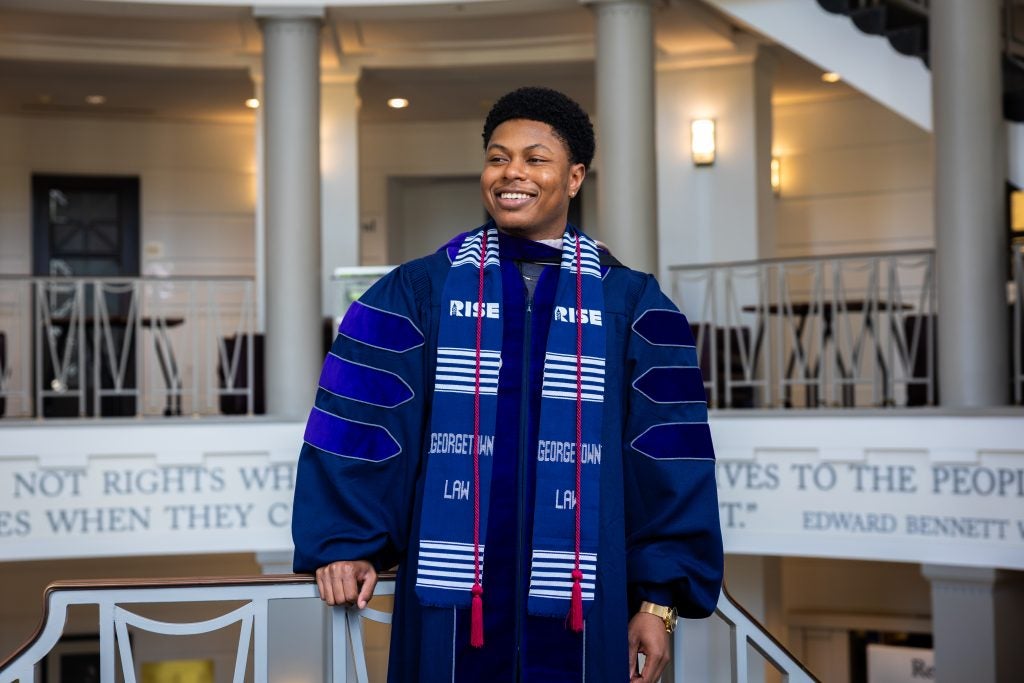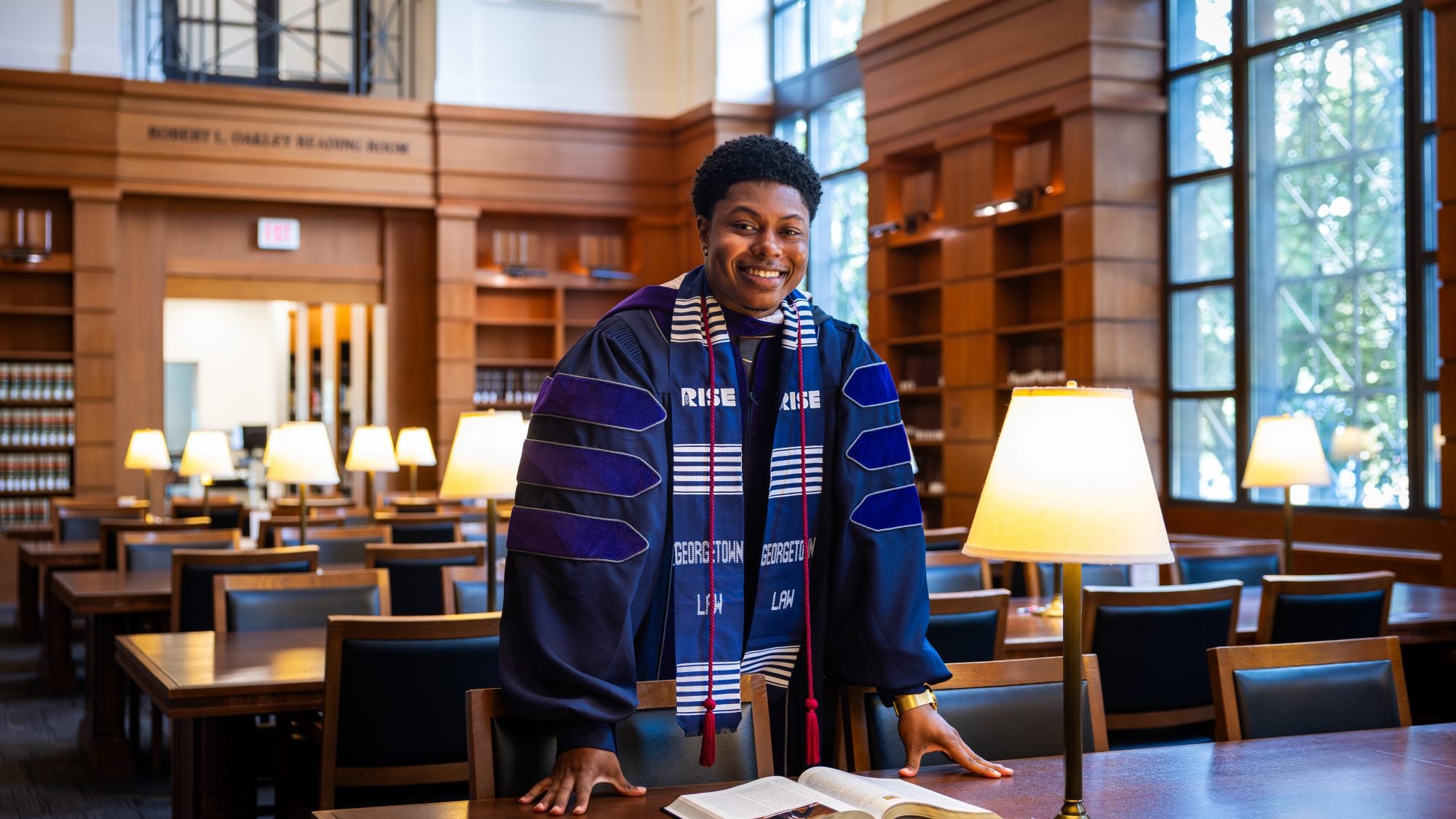
A man in a purple graduation gown stands in a library
Category: Student Experience

Title: He Studied for the LSAT While Working as a Janitor. Now, He’s Graduating From Georgetown Law.

Five years ago, Rodney Wolfe (L’26) sat in a bathroom stall huddled over an LSAT prep book.

He was on his break as a janitor at an Amazon warehouse in Atlanta, Georgia. It was the night shift. And Wolfe wanted to cram in as much study time as he could. 

“I was like, ‘I’m going to figure out a way to make it work.’ So that’s what I did,” he said.

On May 17, after 80-hour work weeks and late-night study sessions, Wolfe will walk across the graduation stage in a navy robe and his juris doctor in hand.

He will officially be a graduate of Georgetown Law.

“My proudest accomplishment is just being here,” Wolfe said. “Being able to be a graduate of Georgetown Law — that cannot be understated.”

Wolfe will be the first person in his family to graduate from law school. 

For the 27-year-old, this moment is not just about his accomplishment. It’s about his mother, who plans to whistle for Wolfe from her seat. His father, who worked with him as a janitor at Amazon. His cousins, his aunt, his community back home in Georgia, the people he wants to give back to. 

“This moment is a coming together of all the effort that so many people have put into me, that I’ve put in,” he said. “It’s important for me to bring what I learned from the law and help the people who have helped me and supported me to get me to where I am today.”
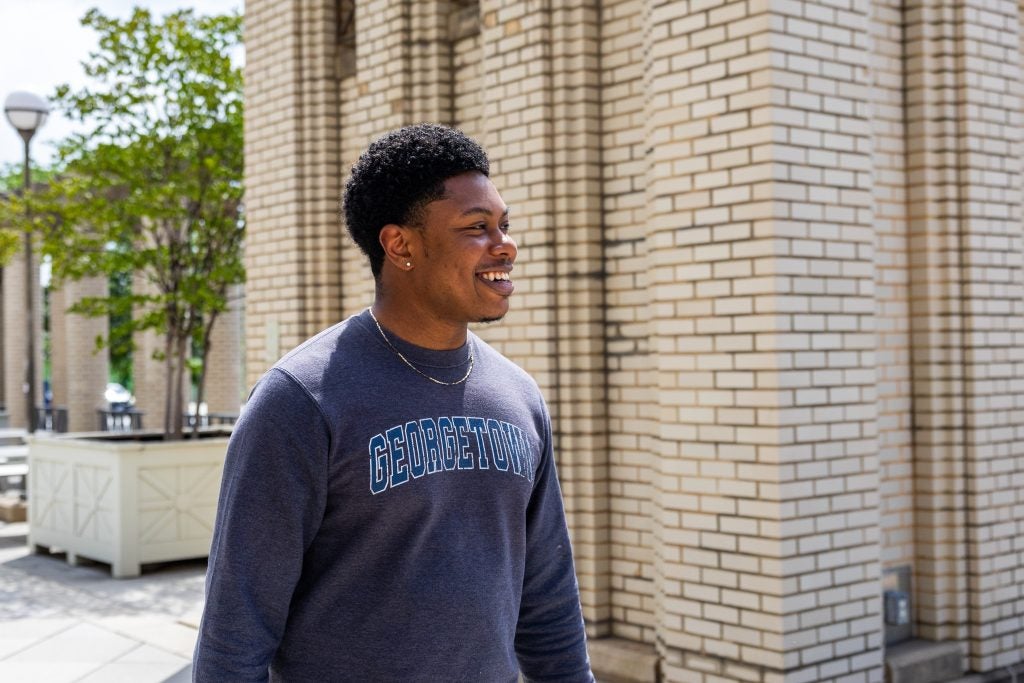

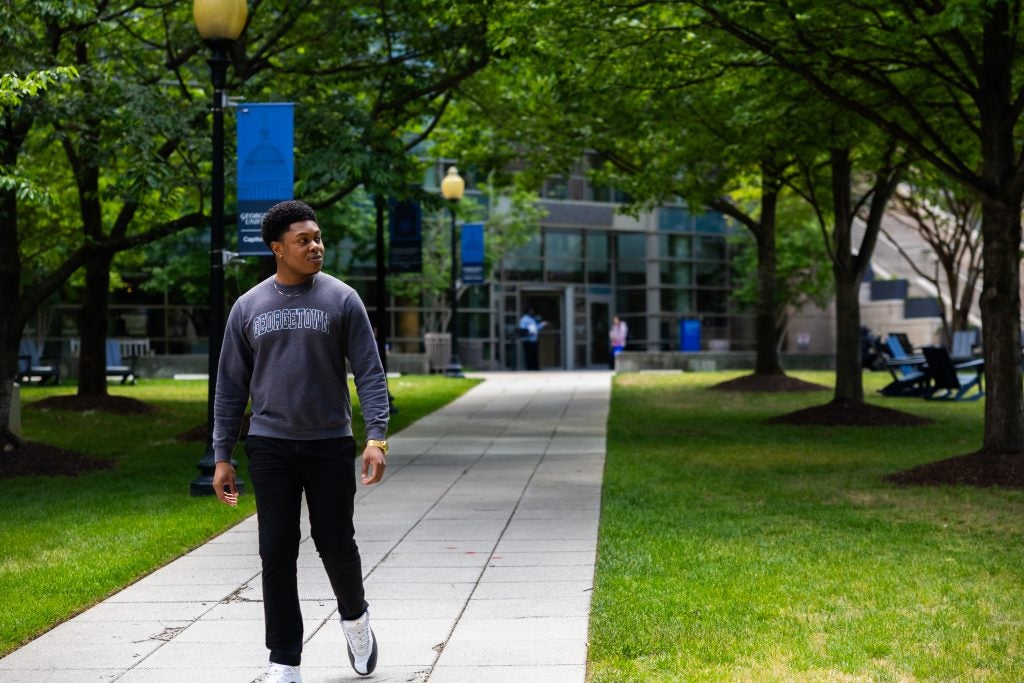
A young man smiles while wearing a Georgetown long-sleeve shirt and walking outside
Wolfe arrived at Georgetown Law in 2023.
A childhood photo of a mom holding her son in a portrait session
Wolfe with his mom, Schnequa Baldwin.

Growing up, Wolfe’s mom had a saying that stuck with him.

“‘If you can’t go through the front door, go through the back. If you can’t go through the back door, create a door for yourself. You have to be tenacious and persistent,’” he said. “It helped me navigate through the adversity I’ve been through.”

Wolfe grew up in a low-income, primarily Black neighborhood in Clayton County, Georgia, south of Atlanta. He loved to read and write, and his parents directed his inquisitiveness — “I always asked why things were the way they were” — into academics. 

In high school, he moved in with his aunt, who lived in a higher-income neighborhood. His mom wanted him to have more access to academic resources, he said. Once there, his career sights bloomed.

“Seeing Black affluence and Black wealth really inspired me,” he said. “It made me say, ‘This is something I can do. It’s attainable.’ I didn’t know how I was going to get there, but I realized if I worked hard enough and if I followed my mom’s mantra, ‘If you want it, you make it happen.’ So that’s what I did.”

Wolfe graduated from the University of West Georgia as the valedictorian of the Philosophy Department. He planned to go to law school afterward, but his LSAT score fell short of his target schools. So he found a different door. 

Night Shifts and Study Shifts

Wolfe got a job as a janitor at an Amazon warehouse. He’d clean bathrooms, sanitize floors and dust ceilings from 6:30 p.m. to 4:30 a.m. 

On his break, he practiced LSAT logic puzzles on the breakroom whiteboard. Then he’d come home, sleep for a few hours and study before he went to work again. 

For two and a half years, Wolfe juggled multiple jobs: as a janitor, unloading heavy boxes from Amazon trailers, DoorDashing and working as a customer representative at State Farm. All while studying, studying, studying. The pace was grueling.

“Some days and some periods of time I just didn’t want to do it,” he said. “My mom would see me in these moments where I was kind of sad or didn’t want to be in that position. She would always say the only time you fail is when you stop trying. So I never stopped trying.”

While at Amazon, Wolfe worked with his dad, who managed the janitorial staff. His father’s tenacity inspired him, too. 

When Wolfe felt ready, he took the LSAT and scored in the 95th percentile. In 2023, he was accepted to Georgetown.

“I felt like my whole life had done a 180, and, to be honest, it did,” he said.

A young man walks on a sidewalk on Georgetown Law's campus
After graduating, Wolfe plans to pursue a career in civil rights law.

Community Service and Law School

At Georgetown, Wolfe has found his own path in law. 

He has participated in Georgetown Law’s Civil Rights Clinic, which represents clients in issues of discrimination, constitutional rights and workplace fairness. He served as a student attorney, writing briefs and motions for four clients.

“That for me was the time where I was like, this is why I came to law school,” he said. “I’m helping people. I can see a tangible benefit to the things I’m doing, and I feel like I’m making a difference.”

His clerkship at a veterans disability law firm reinforced his desire to pursue civil rights law when a brief he wrote secured help for a veteran. 

“That was my first ever brief that I was able to get a win on, and it was great,” he said. “Like I’m making a positive impact on someone else’s life just through my writing.”

The Washington Bar Association Educational Foundation also recognized Wolfe for his writing: In 2025, he was awarded first place in the Charles Hamilton Houston Essay Scholarship, named in honor of an influential civil rights attorney.

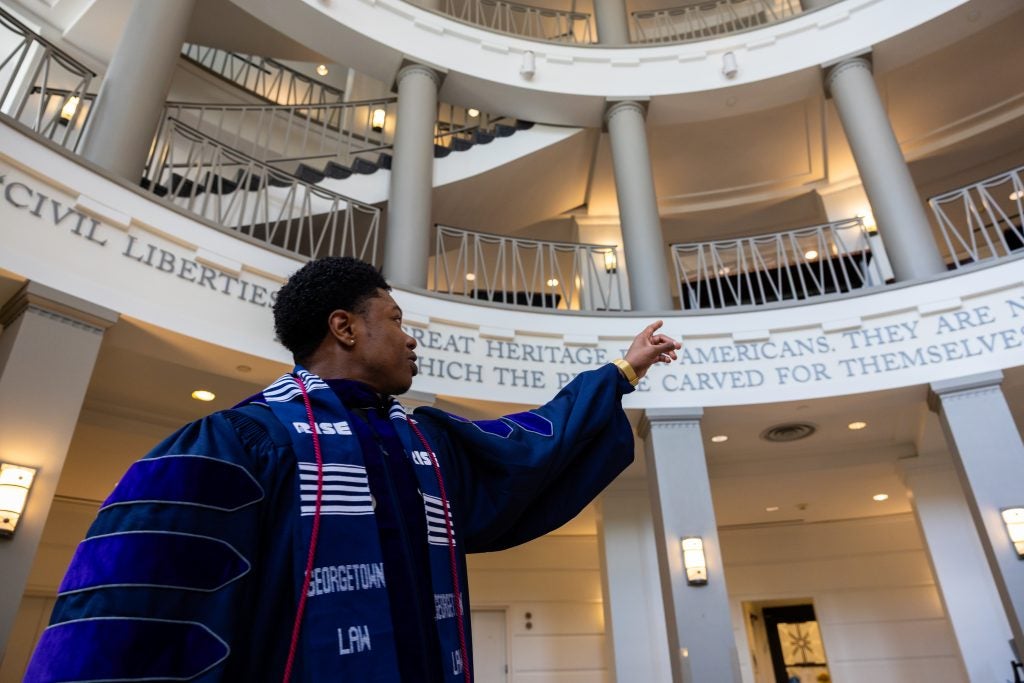
A graduating law student in a purple graduation gown points up at a circular lobby
Wolfe at Georgetown Law’s Edward Bennett Williams Law Library.

Outside of the classroom, Wolfe was a fellow in RISE, a program designed for students with less exposure to the legal field prior to law school, and volunteered in the Black Law Students Association. Both groups have given him a sense of family and love, he said. 

He also volunteered with a nonprofit that furthers economic mobility in Black communities and tutored those who couldn’t afford an LSAT practice course. 

“Georgetown has a mission of community service and being community-oriented, and they really push that,” he said. “It’s been a transformative experience in a lot of ways where I’m discovering different parts of myself.”

Eventually, Wolfe wants to become a civil rights attorney and help communities like the one he grew up in. 

“Being able to have an understanding of the law and an understanding of how the law has implications for certain groups of people, particularly the people that I was raised around in the community that I’m from, it’s very important for me to have that skillset,” he said.

He also wants to empower young Black men to gain access to educational and work opportunities as he did.

“I want to make a positive impact for other people, because it doesn’t make much sense to climb up a ladder and then pull the ladder up after myself,” he said. “It’s important for young men who look like me to see that representation.”

The week before he graduates, Wolfe walks through Georgetown Law’s campus in downtown Washington, DC. Two Law Center security guards pass by him.

“I’m so proud of you!” they each call out. 

For Wolfe, the sense that he’s about to graduate is slowly kicking in.

“It’s starting to feel real,” he says. 

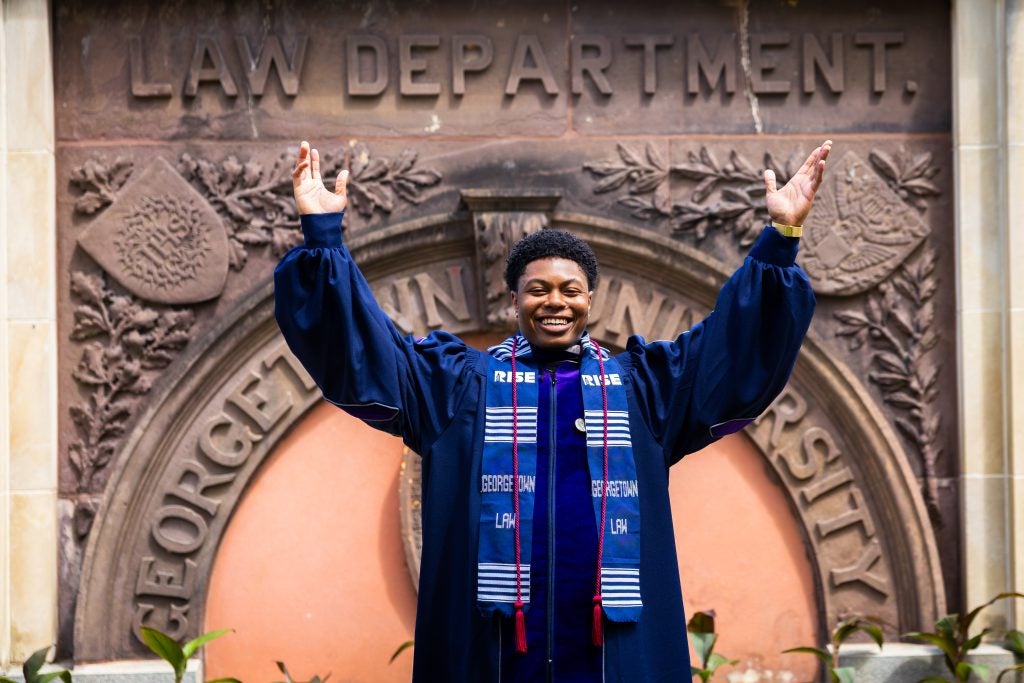
A young man smiles while wearing a purple graduation robe