Category: Discovery & Impact
Title: Adapting ‘The Odyssey’ Is a Challenge of Mythic Scale. Why Do We Keep Returning to This Ancient Epic?
Date Published: July 9, 2026
This story is a part of our Ask a Professor series, in which Georgetown faculty members break down complex issues and use their research to inform trending conversations, from the latest pop culture hits to research breakthroughs and critical global events shaping our world.
Even if you haven’t read “The Odyssey,” you probably know the plot.
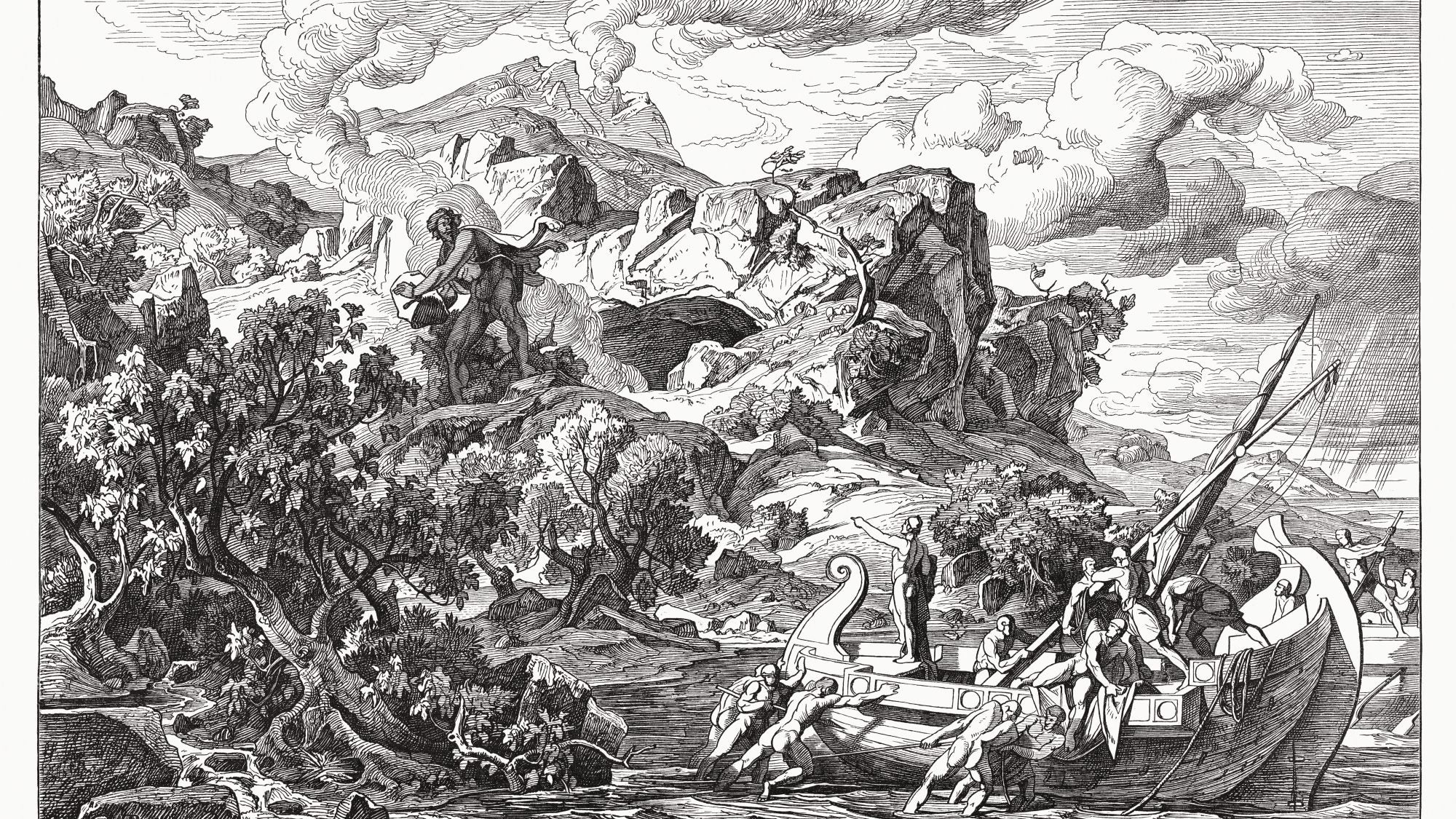
Homer’s epic poem centers on Odysseus and his 10-year quest to return home to his wife Penelope and his rightful place as king of Ithaca after the Trojan War. Along the way, he outwits gods and monsters with a little divine intervention.
Sound familiar? This classic tale of a hero’s journey is one of the most influential works of Western literature and has inspired writers, poets and artists since it took its current form over 2,700 years ago. Versions of Odysseus have sailed across screens in shows like “The Simpsons” and movies like “O Brother, Where Art Thou?,” and this summer, a Christopher Nolan film places Matt Damon in the hero’s sandals.
Why does this ancient poem continue to captivate audiences and writers through the millennia? Because it illustrates what it means to be human and mortal, says Alexander Sens, the Markos and Eleni Tsakopoulos-Kounalakis Professor of Hellenic Studies in the College of Arts & Sciences.
“Odysseus loses his identity,” Sens said. “The real threat of the poem is that Odysseus will become invisible and will not be remembered, and it emphasizes that we live on in the stories people tell about us.”
Learn about the challenges of adapting an ancient play for modern moviegoers, what makes an historically accurate adaptation impossible and why 21st-century audiences feel called to the Greco-Roman classics.
Ask a Professor: Why Are We Obsessed With ‘The Odyssey’ and Adapting Greek Classics?
How did “The Odyssey” come about?
“The Odyssey” and “The Iliad” are the end products of an oral tradition that goes back a long time. In fact, some of the linguistic features of both epics suggest that they extend to a time before Greek formed into what we would recognize as Greek, part of the proto-Indo-European tradition. Think about these epics as orally transmitted stories that grew by retelling, with innovations added at every stage.
I’m also a musician, and the example I give to my Greek literature classes is to think about these works like the birth of jazz, blues and rock-and-roll.
What’s the connection between Greek literature and rock-and-roll?
Consider a kid playing blues guitar in the Mississippi Delta in, say, the late 19th century: That kid didn’t learn from sheet music or YouTube videos. He learned from his forebears, and as the music was passed along, new elements like riffs or licks were continuously added to exist alongside earlier features. It’s a vibrant, dynamic tradition that bifurcates and trifurcates, and becomes a number of genres.
That’s what happened with Homer — the precise mechanics of how oral poems like “The Odyssey” came to be fixed are not so clear. Even to speak of Homer as the ‘author’ is complicated.”: There may well have been a person called “Homer,” but he is not identifiable as a historical individual in the way the ancients imagined.
What themes within “The Odyssey” have since become hallmarks of contemporary narratives?
To put it simplistically, a hero withdraws from his community, bad things happen in the community as a result, and the hero returns and order is restored, though not without loss. The Homeric epics handle the relationship of the hero to his wider community in particularly interesting and nuanced ways.
There’s also the complexity of the hero’s status. Greek heroes stand in some sense outside the realm of ordinary men, and that often creates moral ambiguity. To be a hero in Greek literature doesn’t mean that you are altruistic. Odysseus isn’t a hero because of certain moral qualities — it’s that he has a special status that gives him a privileged, proximate relationship to the gods.
To compare the sublime to the ridiculous, if we’re watching a movie from the Marvel universe, we can see that Tony Stark isn’t necessarily a good guy, but he has qualities that make him transcend what it is to be a familiar person.
What are the challenges of adapting “The Odyssey” to film?
Doing “The Odyssey” is a really hard challenge, and I am not sure that there’s ever been a perfect adaptation. Odysseus is a complicated, often mendacious narrator who doesn’t translate perfectly to screen.
All the well-known adventures that Odysseus describes in books nine through 12 are stories that he tells, and the poem elsewhere makes it clear that we have to be careful about taking what he says at face value. We generally accept that the stories he tells in these books represent his real experience, even though some ancient writers understood them to be fiction. On film, if you show those episodes, you appear to authorize them.
What aspects would make an adaptation of “The Odyssey” feel authentic to you?
A big one has to do with Odysseus’ motivation. “The Odyssey” opens with Odysseus on an island and involved with the goddess Calypso, who’s going to make him immortal. The poet says, ‘but he was yearning for his wife Penelope the whole time.’ One reading of that is a romance, and “The Odyssey” became very influential on ancient Greek romance writers in a later period. Some ancient critics even thought the poem ended when the couple reunites. But it doesn’t, and that reflects the fact that there are other issues at play, like the reintegration of Odysseus into the community and his reunification with his son and father.
Getting the ambiguity of Odysseus’ status right also matters to me. To be a hero in ancient Greek literature reflects a status above that of ordinary men, and that is never a simple matter. Odysseus is a complicated and, in some ways, problematic figure.
There have been conversations about the perceived historical inaccuracy of Christopher Nolan’s “The Odyssey.” Is historical accuracy important in Greek mythology adaptations?
That type of objection doesn’t recognize the way that tradition developed. To talk about what’s ‘real’ in Homer is a misnomer.
Homer’s works developed over a long period of time, and their specifics are diachronically diverse — they have artifacts and traditions that entered at different times, going back hundreds of years.
For example, there’s a reference to a boar’s tusk helmet in “The Iliad.” We know this was a real Bronze Age artifact, but when this poem was coming into its final form, people did not wear them.
The boar’s tusk helmet is an anachronism that reflects the way the tradition developed by accretion. By adapting Homer’s narratives, we become part of the tradition and add our own elements to it.
What makes the field of classics and Greco-Roman antiquity so interesting to the contemporary Western world, especially in comparison to other ancient civilizations?
We have better access to the Greeks and the Romans, in some sense. There’s a line that goes through the European tradition to them, and we have a relatively abundant volume of surviving literature and a way of reading it that makes it seem like the Greeks and Romans are our knowable ancestors.
But there’s a huge gulf between the Greeks and Romans and us. Classicists increasingly recognize how unknowable their world is to us, except as the product of projection. There’s a kind of fantasy that the Greeks and Romans lived very romanticized lives and that they were better people than we are, and that’s manifestly not true. It was brutal to live in antiquity, in terms of creature comforts, violence, the status of women and slaves and many other factors.
What modern popular narratives do you think will stand the test of time in the way that “The Odyssey” has?
I can’t imagine any. What we have to understand about “The Odyssey” and “The Iliad” is that they were foundational for the entirety of Greek culture. They lie behind the poetic tradition that comes after them. In that sense, we have a way more fragmented artistic and cultural landscape that doesn’t have singular, shared foundational texts.
What lesser-known poetry would you recommend to people who enjoy “The Odyssey” or who are interested in Greco-Roman literature?
For Greek poetry, I love “The Argonautica” by Apollonius of Rhodes, which tells the story of Jason and the Argonauts. It’s especially interesting if you know “The Iliad” and “The Odyssey,” and it’s much shorter — it’s a poem in four books.
I’ve long worked on an extremely challenging poem called “Alexandra,” by Lycophron. It is a retelling, or perhaps a “pre-telling,” by the prophet Cassandra of the events of the Trojan War and its aftermath. It engages in really interesting ways with the Homeric tradition.
In terms of Roman epics, obviously one would want to start with Vergil’s “Aeneid,” which fundamentally informed later epics. Lucan’s “Pharsalia” narrates the Roman Civil War. The poet Statius’ “Thebaid” tells the story of the conflict between Oedipus’ cursed sons.