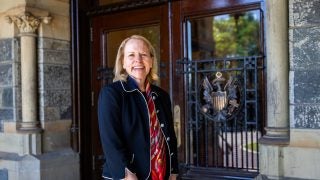
Alison Mackey, the former chair of Georgetown University’s Department of Linguistics and an internationally recognized researcher, has been appointed vice president for Graduate Studies at Georgetown.
Mackey will begin her three-year term on July 1, 2026, following 28 years of teaching, research and leadership in the Department of Linguistics. She succeeds Alexander Sens, interim vice president for Graduate Studies and dean of the former Graduate School of Arts & Sciences, in leading Georgetown’s recently established Office of Graduate Studies. The office supports graduate education and community as a central resource across schools and campuses.
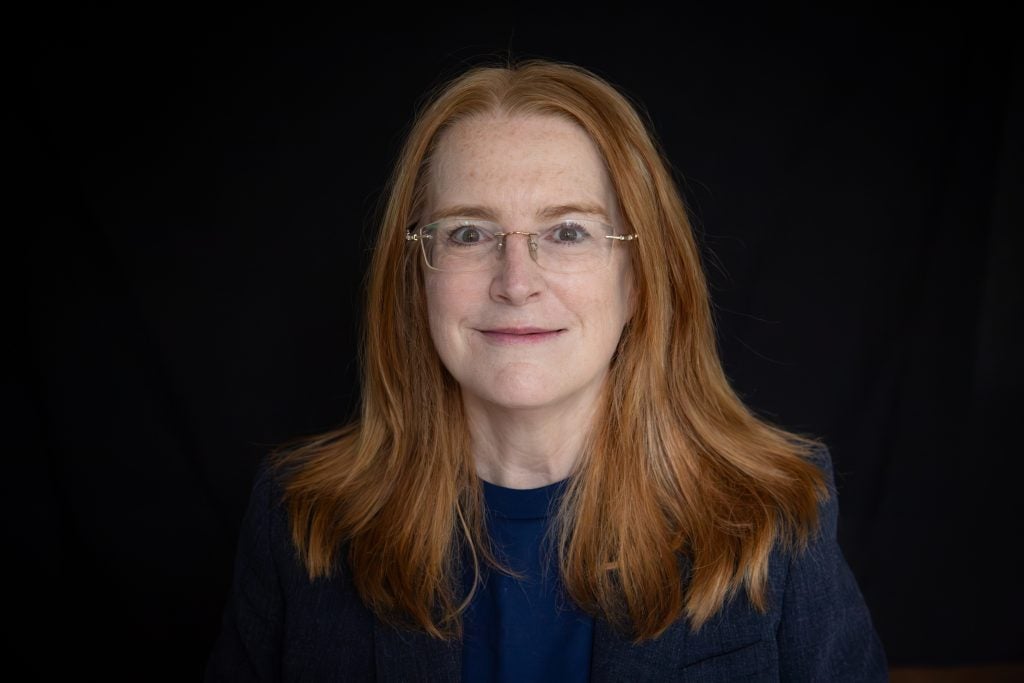
“We are pleased to name Alison Mackey as the new vice president for the Office of Graduate Studies,” said Soyica Diggs Colbert, interim provost of Georgetown University. “Alison’s longstanding ties to Georgetown demonstrate a proven dedication to supporting students, faculty and staff across the university. We look forward to seeing her vision for the future of graduate education at Georgetown come to life.”
Mackey is one of the world’s most highly cited scholars in applied linguistics, second language acquisition and research methodology. She has published over 150 journal articles and book chapters and 22 books, and received several prestigious prizes in her field, including the American Association for Applied Linguistics Distinguished Scholarship and Service Award, the Modern Language Association’s Mildenberger Prize and the International Association for Task-Based Language Teaching (TBLT)’s Distinguished Achievement Award.
Mackey joined Georgetown in 1998 as an assistant professor of linguistics and became a professor in 2008. She was appointed chair of the Department of Linguistics in 2021 after serving two terms as the director of graduate studies. She has held a wide range of roles across the university, including as a member of the Faculty Senate.
“I’m thrilled, excited and proud to take on this role, and to continue working in partnership with my Georgetown colleagues to advance graduate education and research across the university,” Mackey said. “I’m looking forward to connecting graduate students, educators and support systems across our campuses to bring our community together in new ways.”
Mentorship Made All the Difference
Born in the Midlands in England, Mackey credits her mother, Deanna Mackey, for her success.
“While I did not come from an academic family, my mum had absolute confidence that I could do anything I wanted,” Mackey said. “Everything I’ve achieved in academia, I owe to my mother for believing in me and giving me that all-important confidence.”
Her mother also indirectly inspired Mackey’s early interest in second language learning. The two moved to Wales when Mackey was young, where Mackey attended a small village primary school with Welsh immersion classes. Mackey, who knew no Welsh initially, remembers struggling to understand her peers and the Welsh curriculum.
“For a while we had a substitute teacher where, if you accidentally spoke English during the Welsh part of the day, you had to write the word down on a piece of paper, go out into the school garden with a spoon from the cafeteria and bury the paper,” she said. “I was out there more than once, and that’s where my interest in applied linguistics grew, from me asking myself, ‘How come it’s so hard to speak Welsh?’”
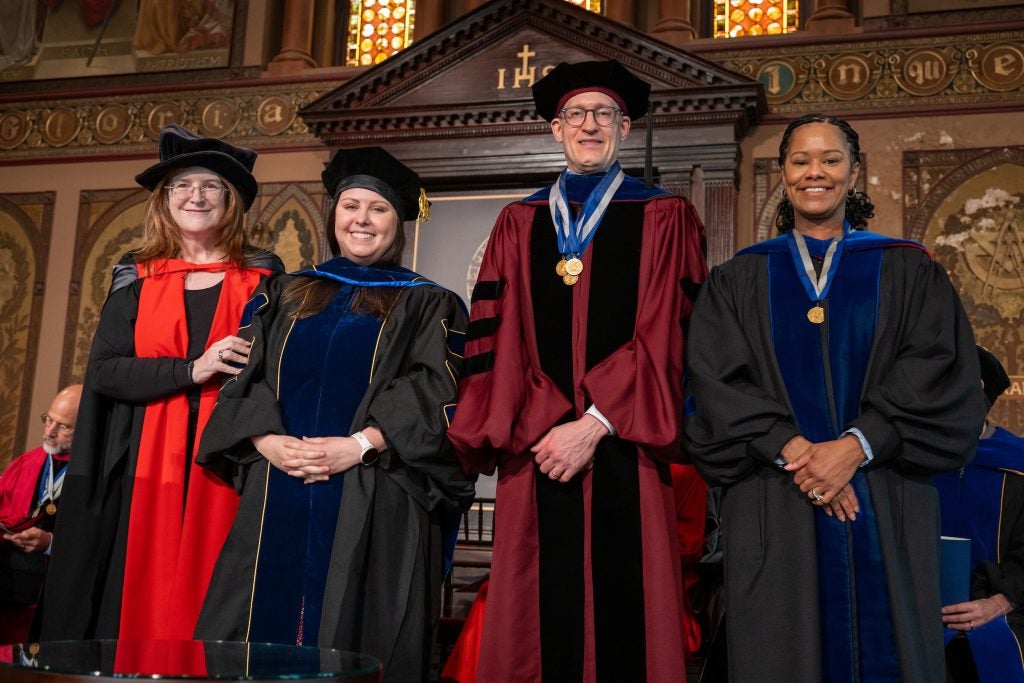
Mackey earned a bachelor’s degree from Lancaster University, followed by a master’s of philosophy in linguistics from the University of Cambridge. After a stint teaching English in Japan, she moved to Australia to earn her Ph.D. in linguistics from the University of Sydney.
At Cambridge, Mackey was part of the first class of women to attend the then-446-year-old Magdalene College. While the integration of female students sparked protests by some male classmates, this only spurred her to work even harder.
Throughout her education, Mackey developed relationships with academic mentors who empowered her to pursue a career in research and teaching with the same sort of confidence and belief as her mother. Mackey strived to carry these examples forward as she grew into mentor roles.
“I’ve always tried to convey to my students the same confidence that was conveyed to me,” she said. “People often ask what I’m most proud of in my career, and number one is always my students.”
Nearly Three Decades a Hoya
When Mackey came to the United States in 1993, she initially conducted research and taught English at the University of Pennsylvania. Afterward, she spent three years teaching and directing a master’s program as an assistant professor at Michigan State University before joining Georgetown, eager to teach and expand her research opportunities in DC’s international hub.
Mackey embraced the Georgetown community from the start. She is proud of two key courses within her department that she developed with colleagues: one a research experience for undergrads that connects them with graduate student mentors, the other a professionalization course focused on Ph.D. students and their navigation of research, teaching and academia.
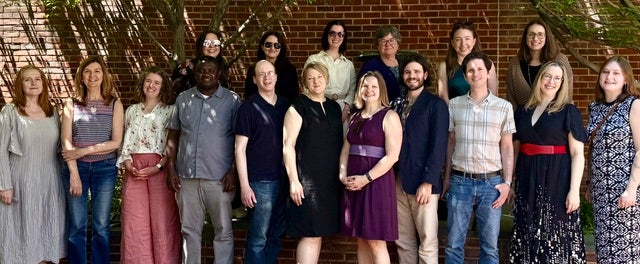
“I enjoy working with students at every stage of their education, and as a researcher, I like training students and encouraging their fantastic ideas,” Mackey said. “I also feel privileged to be part of grad students’ journeys. I like the energy and tremendous potential that they bring to campus. I am sad to say goodbye when they leave, but excited and happy for the next step on their journeys.”
Serving on numerous panels around the university, including the University Budget Committee and various school executive committees, deepened Mackey’s cross-campus connections and introduced her to the successes and challenges of university operations. Each interaction broadened her perspective beyond the Hilltop campus to Georgetown as a comprehensive ecosystem, she said.
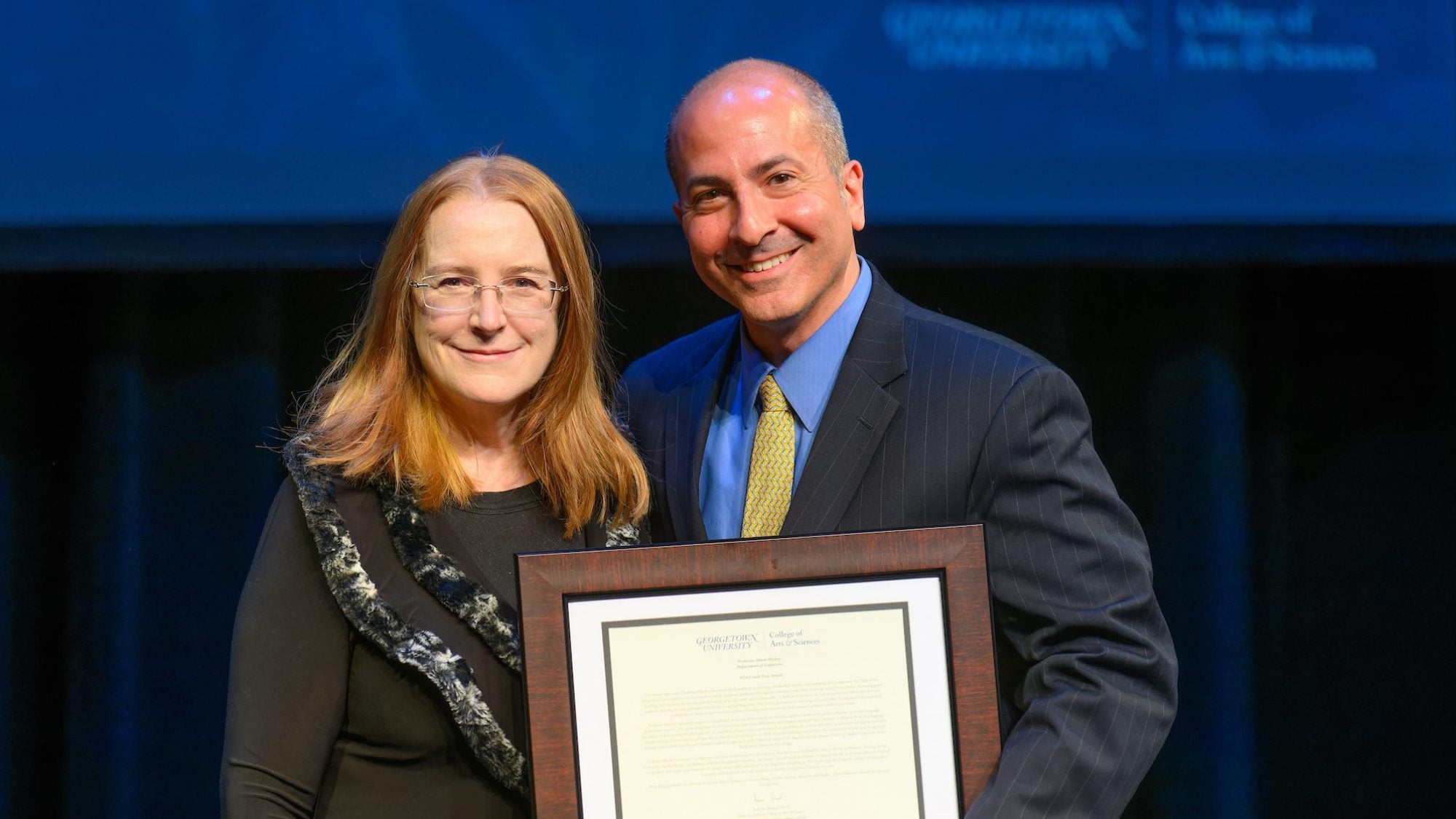
In 2019, Mackey received the President’s Award for Distinguished Scholar-Teachers and the Provost’s Career Research Achievement Award, and she was awarded the College of Arts & Sciences’ Condé Nast Award in 2025.
Even as her profile rose internationally with publications, awards and a 12-year appointment as editor-in-chief of Cambridge University Press’ Annual Review of Applied Linguistics, Mackey chose to stay at Georgetown because of its community.
“My academic home has always been the Hilltop,” Mackey said. “Georgetown has truly exceptional people amongst faculty, staff and students”
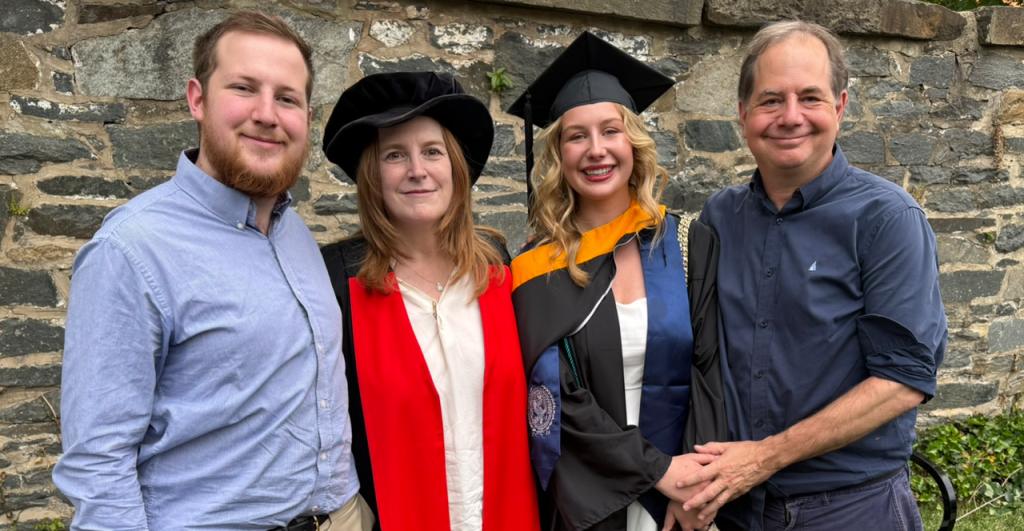
And this year, Mackey added Hoya Parent to her Georgetown resume when her daughter, Miranda, graduated with her bachelor’s from the School of Foreign Service.
Shaping the Future of Graduate Education
Mackey is approaching her new role with a researcher’s mindset during a time of significant internal and external transformation for the graduate education landscape.
In 2025, Georgetown’s former Graduate School of Arts & Sciences began a two-year evolution to the Office of Graduate Studies. Mackey sees this development, which was designed to more efficiently support graduate programs and students across the university, as a moment of significant opportunity.
“I’m naturally curious about systems and people, and I’m interested in analyzing how things work and making them work better,” Mackey said. “I’m excited to work within this new, cross-campus structure as it develops.”
With the guidance and insight of university-wide, graduate-focused teams, Mackey is prioritizing graduate enrollment, alumni engagement and improving access to student resources as she assumes her new responsibilities.
“It’s incredible to be able to take this step forward together with the community I know and love,” Mackey said.