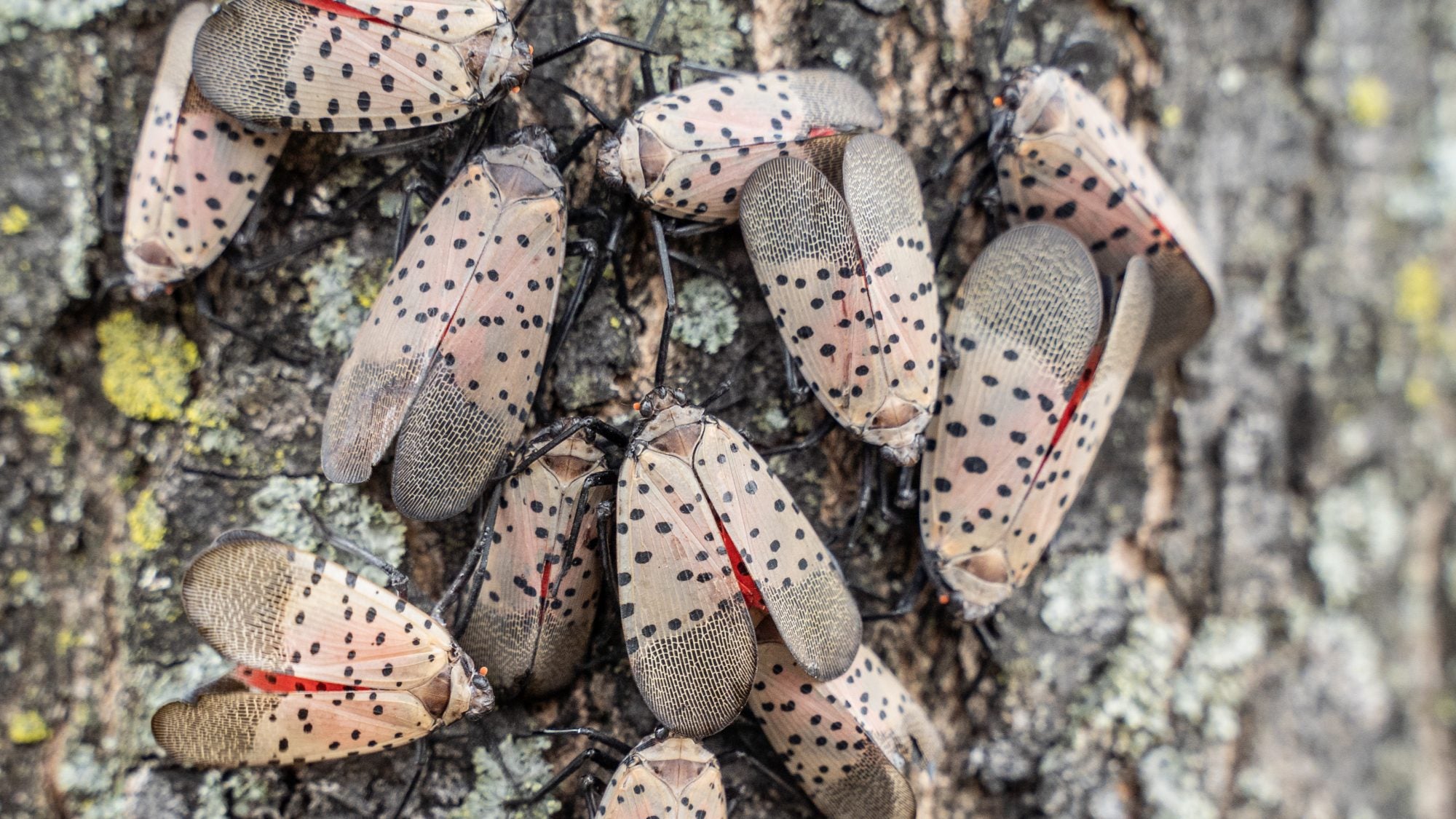
A new winged terror — or at least a nuisance — may be a regular at your backyard barbeques and morning walks this summer.
No, it’s not another historic brood of cicadas. But this summer, billions of spotted lanternflies could feast on your gardens and local plant life.

The invasive species from Asia is known for feeding on plants and leaving behind a sticky residue in its wake. What started as a small infestation in Pennsylvania has since spread to much of the Northeast, Mid-Atlantic and Midwest regions of the U.S.
While there was hope several years ago of stomping out these insects when they first arrived around Washington, DC, a Georgetown entomologist and biology professor is a little less optimistic about expelling the invasive species from the region.
“They are here to stay,” said Martha Weiss, a biology professor and entomologist in the College of Arts & Sciences. “I think the nymphs and adults are quite exotic and beautiful, and worth a closer look. My new motto: If you can’t beat them, appreciate them!”
Learn more from Weiss as she explains the lifecycle of spotted lanternflies, how they affect the environment and, perhaps most importantly, what to do if you spot one in your neighborhood.
Ask a Professor: An Entomologist Explains What to Expect From Spotted Lanternflies This Summer
Where did the spotted lanternflies come from, and why did they migrate to the DC area?
Spotted lanternflies are native to China, India and Vietnam. They were first reported in the U.S. in Pennsylvania in 2014 and have been steadily spreading outward from there. They are now reported in at least 20 states and DC, and their range is continuing to expand throughout the mid-Atlantic and New England.
Spotted lantern flies didn’t migrate to DC on their own. They are poor fliers, but their eggs are excellent hitchhikers, as they are compact, sturdy and well-camouflaged. They are thought to have arrived in Pennsylvania as eggs on a shipment of stone from Asia. Within the states, they also move long distances with help from humans – on cars, trucks, trains, nursery plants, furniture, firewood and other items stored outdoors.
When did they first appear in DC? Are these insects here to stay?
They first appeared in large numbers in DC in 2023, though I didn’t see them on campus until last year. They are likely here to stay, and we will need to get used to these exotic newcomers, as we have the Asian tiger mosquito, the Japanese beetle and many of our ladybugs and earthworms!
Do we expect more spotted lanternflies this year than in the past?
This seems to be a big year for lanternflies in the District, as their population has been increasing steadily. When they are new to an area that contains suitable host plants, and where predators have not yet learned to recognize them as prey, they can grow unchecked – but now birds, squirrels, spiders and predatory insects are starting to catch on to this abundant new source of fat and protein, and so predation may help to limit their numbers.
How long will spotted lanternflies stick around this season? What happens to them in the fall and winter?
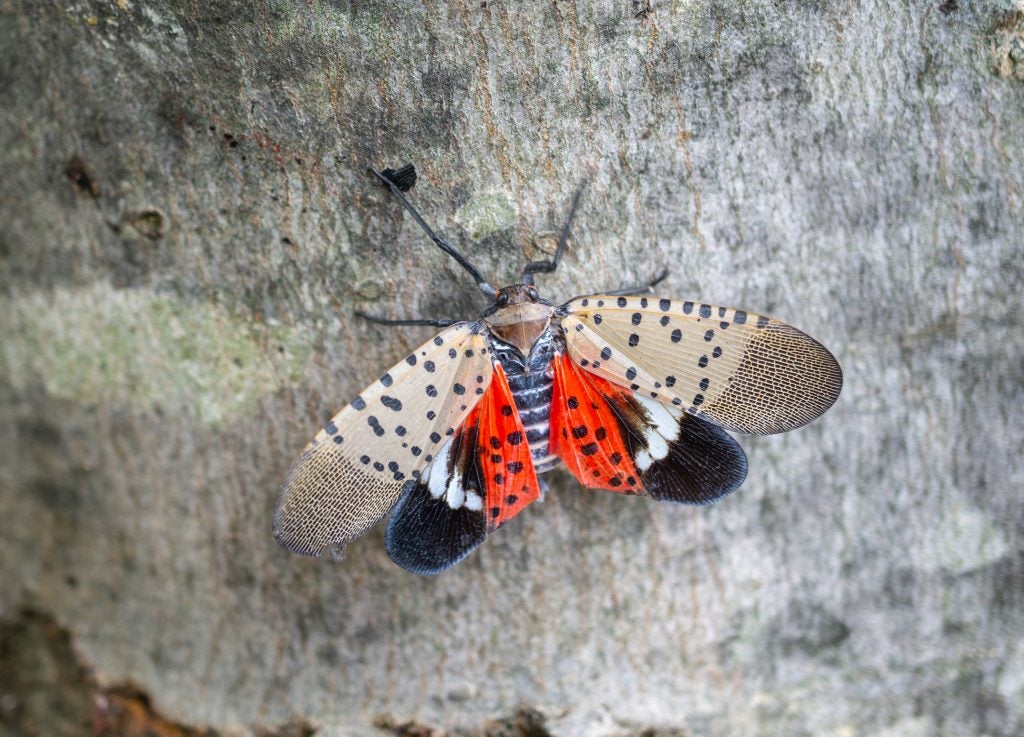
Spotted lanternflies are around all year, but in different phases of their life cycle. They complete one generation annually, passing through three distinct phases: overwintering eggs, four immature nymphal stages and winged adults. The inch-long adults will be pretty obvious starting in mid-July (I saw my first one last week), and they will be flying and jumping around until the first good frost, sometime in October or November. Females start laying eggs in September, but the egg masses can be hard to spot until you develop a search image for them.
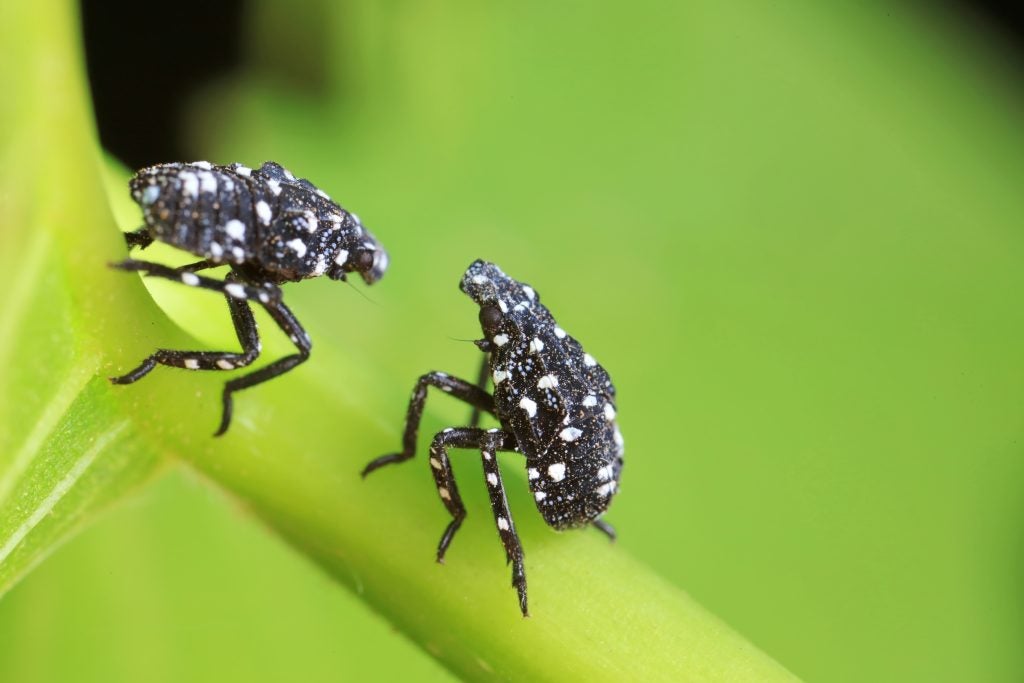
The egg masses are a little over an inch square and contain 30 to 50 eggs in a few tidy vertical rows, covered with a greyish-white putty-like layer that dries to resemble mud or lichen. The eggs survive the winter and hatch starting in April or May — you’ll first see lots of tiny, odd-looking black insects with bright white spots hopping around on leaves. These immature nymphs will molt two more times into larger black jumpers, and the final juvenile stage is a showy, bright red with white spots. The red nymphs then molt into adults, completing the life cycle.
Are spotted lanternflies bad for the environment, other insects, animals or even people?
Let’s start with people – spotted lanternflies are NOT harmful to humans! They don’t bite or sting or irritate the skin, though I suppose that someone could find their erratic jumping a little off-putting. As far as we know, they don’t directly harm other insects or larger animals. Their main impact is on the plants they feed from, and although people were initially worried that they would kill or severely damage their hosts, the harm has been less than anticipated.
Despite the name, spotted lanternflies are actually plant hoppers, not flies – and are related to aphids and cicadas. Like those insects, they use their sucking mouthparts to consume sap, and lanternflies can feed on over 70 plant species. They particularly like Tree of Heaven, grapevines, black walnuts, and some fruit trees, and can be seen congregating on those plants to feed in large numbers.
Spotted lanternflies leave waste that people call “honeydew.” Is the waste just a nuisance, or is it possibly dangerous?
Spotted lanternflies feed on a plant’s phloem sap – that’s the fluid that contains the sugars produced in photosynthesis, so it’s sweet and sticky. They excrete excess phloem, and this sugary substance is called honeydew. Because the larger nymphs and adults often feed in big aggregations on a plant, they produce a lot of honeydew, which drips down and can attract ants, bees and wasps eager for the sugar.
A black sooty mold can also grow on the honeydew, making a mess on porch furniture or flower pots below the infested plants. It can also cover plant leaves and interfere with photosynthesis – but I’d put it in the nuisance category, rather than dangerous. In fact, in late summer, honeybees in Pennsylvania sometimes gather honeydew from beneath spotted lanternfly aggregations and use it to make honey. It’s dark brown and tastes smoky and earthy – not my favorite, but a novelty for sure, and a good demonstration that honeydew is harmless.
What should people do if they see spotted lanternflies? Should we stomp on them?
I’d say we’re well beyond the stomping stage. That might have helped slow things down a little when spotted lanternflies were first arriving in the area, but at this point, the horse has left the barn, and they are here to stay. However, finding and removing egg masses in early spring could be a useful way to limit local populations. We scraped dozens off the walls of our lab and the surrounding trees, and even though we have lots of nymphs around, I expect we’d have many more otherwise. If people are interested, I’d be happy to lead a campus walk next spring, to help folks learn to recognize and remove the egg masses.