Category: University News
Title: Senior Named the Inaugural ACLU Next Generation Leader in Civil Rights and Civil Liberties
Date Published: August 7, 2026
By Kelyn Soong
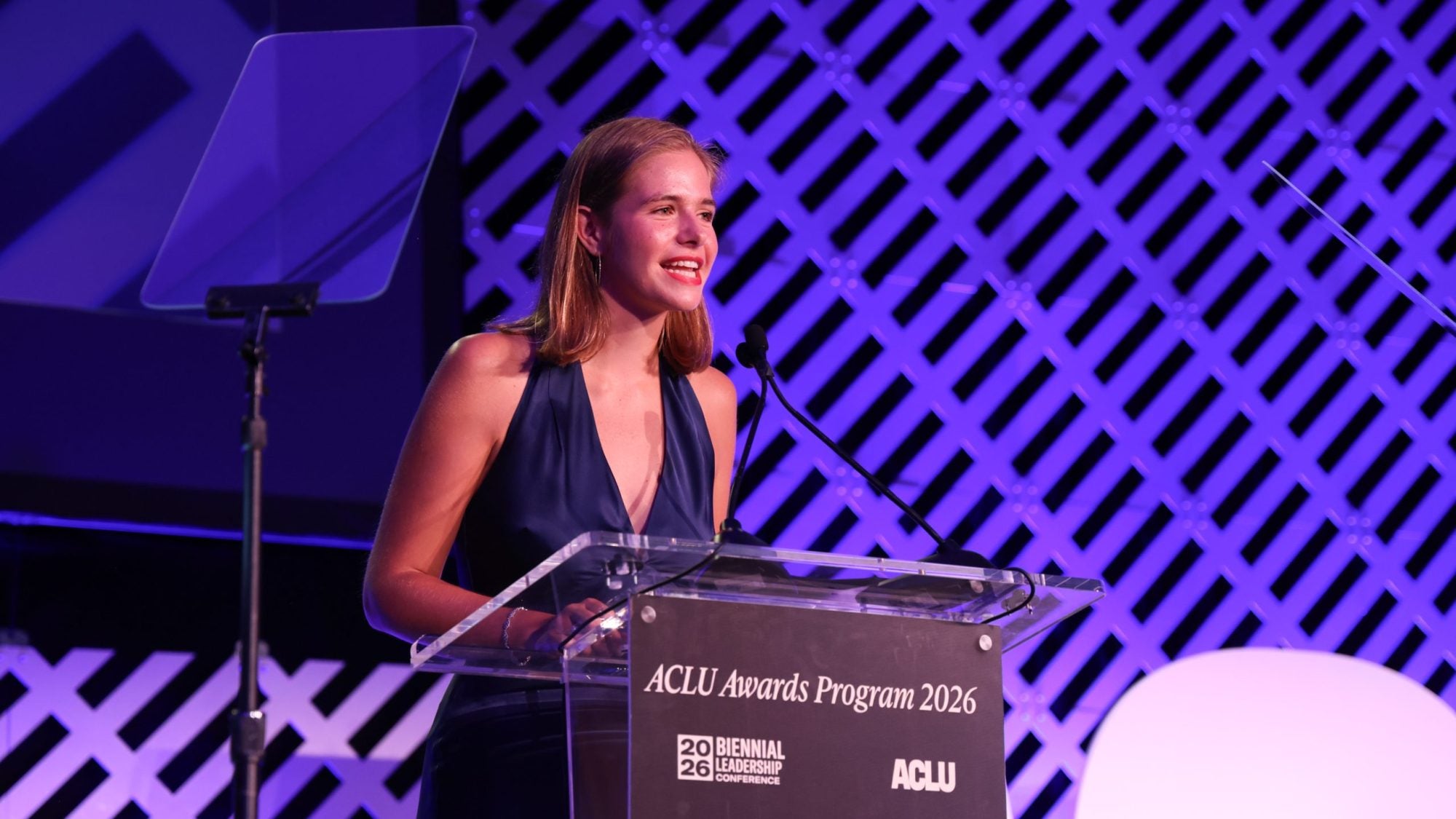
Elizabeth Foster (C’27) stood before a packed room of nearly 2,000 attendees at the Washington Hilton last month for the biennial American Civil Liberties Union (ACLU) awards ceremony recognizing lifetime achievements and contributions to civil rights and civil liberties.
Honorees included music legend Bruce Springsteen, civil rights activist and Super Bowl quarterback Colin Kaepernick — and Foster herself.
Foster, a senior in the College of Arts & Sciences, was named the inaugural ACLU Next Generation Leader in Civil Rights and Civil Liberties for advocacy work fighting against book bans in her hometown of Beaufort, South Carolina.
As she spoke to the room full of global celebrities, advocates, organizers, lawyers and educators, Foster reserved the main message of her speech for the hundreds of high school students gathered in front of her.
You’re “the most powerful people that I see in this room,” Foster told the students with the ACLU National Advocacy Institute. “It is such a surreal and deeply complex experience to get involved in advocacy at a young age; it often feels like having access to the greatest cheat code. When you are a student, people will open doors for you that they would otherwise slam in your face.”
Foster understands the feeling.
She was a student with the ACLU National Advocacy Institute for high school students just three years ago, and her fight against book bans was featured in a documentary film. At Georgetown, Foster has built upon her advocacy work as a campus free speech fellow, student journalist and writing tutor at a local jail.
Receiving the ACLU’s new award for youth activists was particularly meaningful for her, she said.
“I think it’s a really great gesture to have something recognizing contributions from students or from young people in general,” Foster said of the award. “It’s very empowering to me as a student that there’s potential to be recognized in that way. I worked with the ACLU a lot when I was in high school, and I was just so honored they selected me for this.”
The Power of Student Activism
Foster was born and raised in Beaufort, South Carolina, a small town of approximately 15,000 residents.
During her senior year of high school in 2022, complaints from two community members resulted in the removal of 97 books from every school in the Beaufort County School District. In response, Foster and other students began attending school board meetings and drafting public comments against book bans.
The efforts of Foster and fellow student activists Millie Bennett and Isabella “Izzy” Troy Brazoban were captured in a documentary film, Banned Together, which premiered in late 2024. Foster wrote about the experience last year for Teen Vogue.
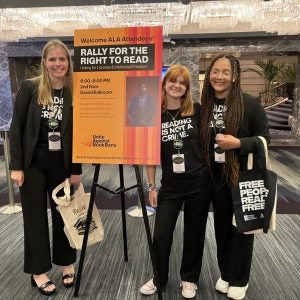
The message of the film, she said, is about student activism and the severity of censorship in book bans. In the film, Howard University law professor Justin Hansford explained that the First Amendment protects Americans’ right to express ideas and receive information.
“I think it can sometimes feel easy to write these things off as not as big of a threat as I think they really are,” Foster said.
With recommendations from community-led review committees, the Beaufort County School District Board of Education eventually returned some of the banned books to the schools. Foster hopes that the film leaves viewers feeling inspired, optimistic and ready to take action to protect the joy of learning and literature.
“It was a really beautiful way that our community came together on this set of shared values,” Foster said. “People weren’t always politically aligned — there was so much political diversity, honestly, in the fight against the book bans. But this brought together people who could understand that this was fundamentally wrong, and that was a really beautiful experience.”
A Culture of Dialogue
Foster came to Georgetown because she wanted to live in a bigger city where she knew people would be politically engaged.
“When I toured Georgetown, it felt like everybody was already doing the things I wanted to do,” Foster said. “It felt like there wasn’t this free space of college and then real life. It was like people were actively working on big important things, and it was just this energy that I was very drawn to, and the idea of being in DC was really appealing to me.”
She chose to major in American studies after taking a First-Year Seminar, Race and Class in DC, with Professor Sherry Linkon.
“I remember one student saying that American studies was the best part of their Georgetown experience,” Foster said. “So that was really exciting to me, and also the classes we get to take, I think that they’re the most fun and interesting classes.”
She worked as one of PEN America’s 2024 Campus Advocates Fellows, and as part of the fellowship, Foster organized a survey about academic freedom at Georgetown. She also served as a Doyle Dialogue Fellow with the Berkley Center for Religion, Peace and World Affairs, interned at South Carolina Appleseed Legal Justice Center and studied abroad in Singapore last fall.
Outside of her classes, fellowships and internships, Foster is a staff writer for The Georgetown Voice and teaches creative writing at the Alexandria Adult Detention Center with Georgetown Students for Prison Justice. She also nannies for three different families in DC.
Foster’s experience at Georgetown and in the College of Arts & Sciences has given her first-hand accounts of the importance of academic freedom and campus free speech.
“The culture that we have in the seminar-style classes — it’s very open,” she said. “I think everyone is so thoughtful and intelligent and has really interesting takes and perspectives. One of the biggest reasons that I think academic freedom and campus free speech are so important is because I can see the result of preserving that at Georgetown, and I think it’s so wonderful to be able to experience. It really does inspire me to protect that for other people.”
Different Paths to Advocacy
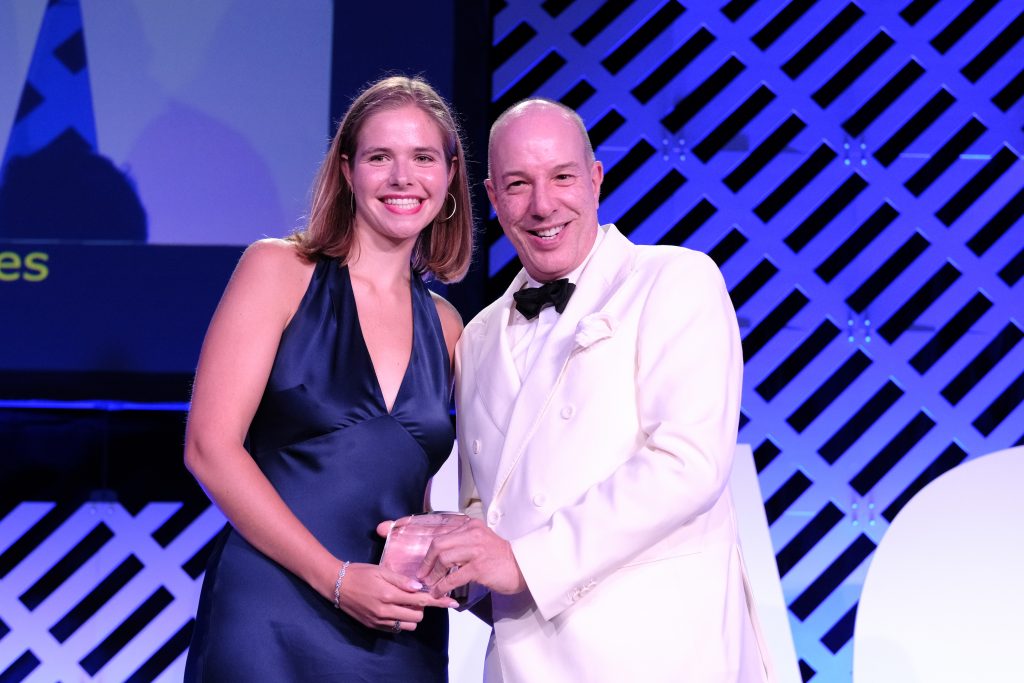
After Foster’s speech at the ACLU awards ceremony, several high school students approached her asking for a photograph and to chat. The moment stuck with her.
“It was really sweet hearing them say how inspiring all of the work I did was,” Foster said. “Because I do think at the end of the day, what is really important to me is that I want other students to be able to have the means to access advocacy and activism and to feel like they have an opportunity to be heard, especially in matters that affect them directly.”
During the ceremony, she met and heard from other honorees, including Springsteen, Kaepernick, Vanita Gupta, a former U.S. associate attorney general and Erwin Chemerinsky, the dean of the University of California, Berkeley School of Law.
The experience reinforced the many different ways to be involved in advocacy work, she said. As she looks ahead to her senior year, Foster is keeping that in mind.
Right now, she is interested in working in education policy and is considering applying to Teach For America. Her mom worked for many years as a preschool teacher, and Foster enjoys being around kids. She wants to work with students and young people.
“I’m really excited to figure out what comes next,” Foster said.
Top photo of Elizabeth Foster courtesy of ACLU.