The Vatican in Rome on a sunny day
Category: Discovery & Impact

Title: Pope Leo XIV Laid Out His Vision for AI. What Is it and What Happens Next?

On May 25, Pope Leo XIV presented “Magnifica Humanitas,” the first encyclical of his papacy, focused on human dignity in the age of AI. 

He signed the document on the 135th anniversary of his namesake Pope Leo XIII’s encyclical, “Rerum Novarum,” which called for protecting human dignity during the Industrial Revolution. 

At that time, some questioned the Catholic Church’s authority to speak on “worldly matters,” Pope Leo XIV wrote in the introduction to his encyclical. Why couldn’t they stay in their lane?

“… The proclamation of the Gospel cannot overlook the concrete lives of people,” the pope wrote. “I therefore wish to add my own voice to this living tradition.”

Over five chapters, Pope Leo XIV presents his vision of AI — one that is hopeful, says Kim Daniels, director of the Initiative on Catholic Social Thought and Public Life. 

“Pope Leo offers a people-first vision of AI, insisting that the measure of any technology is whether it serves every person, beginning with the most vulnerable,” she said. “He grounds that vision in the conviction that a person’s dignity does not depend on what she can ‘achieve or produce.’ AI should be oriented toward the flourishing of all.”

On June 2, Daniels led a dialogue with fellow Catholic leaders about “Magnifica Humanitas,” or “Magnificent Humanity.” 

She was joined by Archbishop Paul Coakley, president of the United States Conference of Catholic Bishops; Emilce Cuda, secretary of the Pontifical Commission for Latin America at the Holy See; Daniel Daly, founding executive director of the Center for Theology and Ethics in Catholic Health; Meghan Sullivan, founding director of Notre Dame’s Institute for Ethics and the Common Good; and Bishop Paul Tighe, secretary of the Vatican’s Dicastery for Culture and Education.
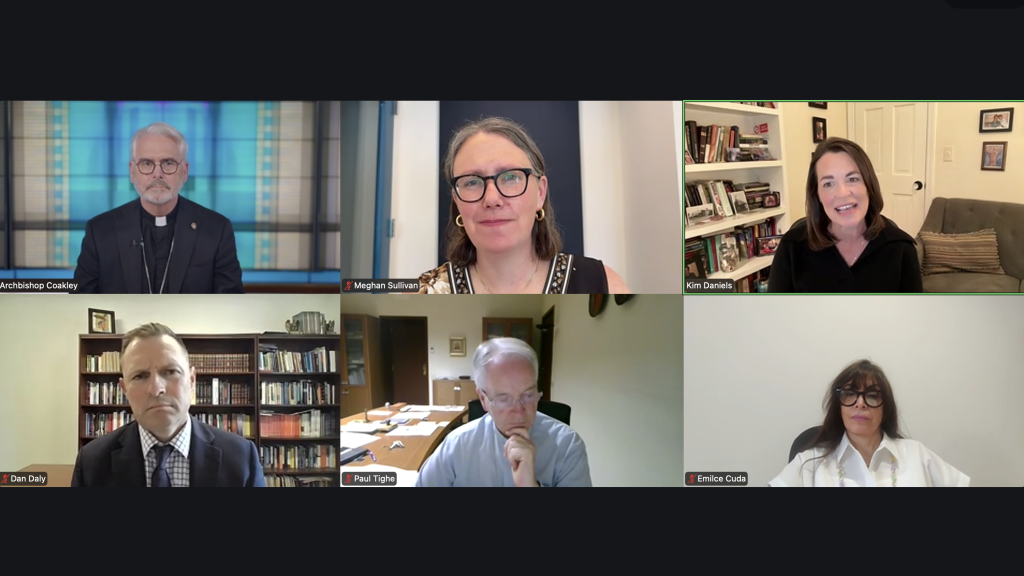
A group of six people listen and talk on Zoom
(From top left) Archbishop Paul Coakley; Meghan Sullivan; Kim Daniels; Daniel Daly; Bishop Paul Tighe; and Emilce Cuda discussed Pope Leo’s encyclical as part of the public dialogue on June 2.

The group discussed the significance and implications of the Pope’s words; AI and Catholic health care; the importance of focusing on the human person in emerging technologies; and how to encourage reflection and discernment offline. 

“The encyclical calls us to ask, in every context – work, family, education, public life – whether our technologies are serving human dignity or eroding it,” Daniels said. 

Learn more from Daniels about Pope Leo XIV’s encyclical, his vision for AI and what the implications and real-world applications of “Magnificas Humanitas” will be.
Q&A: ‘Magnifica Humanitas’ and Pope Leo’s Vision for AI

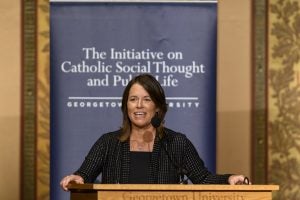
A woman with brown hair and a black sweater stands behind a podium speaking
Kim Daniels is the director of the Initiative on Catholic Social Thought and Public Life.

Why do you think Pope Leo chose to address the topic of AI in his encyclical? Why right now?
“Magnifica Humanitas” delivers on Pope Leo’s commitment to address the challenges and opportunities posed by artificial intelligence. The question is no longer whether AI will transform our world; that transformation is already underway. The real question is whether it will advance human dignity and whether it will reach workers whose livelihoods are being reshaped, as well as those with no seat at the tables where decisions are being made. Pope Leo is weighing in now so that the Church’s moral tradition and global on-the-ground experience can contribute to shaping decisions around AI before they harden into systems.

What stands out to you the most about his encyclical?
The encyclical’s discussion of human limits is beautiful and life-affirming. In a world that treats vulnerability, aging and suffering as defects to be corrected, Pope Leo says something countercultural: The human person doesn’t flourish in spite of limitations, but often through them. Our capacity for compassion, generosity and relationship grows in and through our limitations and dependence on one another. That’s a profound response to the mindsets too often embedded in how AI systems are being built, and it’s unsurprising that a tradition rich in reflection on what it means to be human brings it to this conversation.

What are some of the most salient points he makes about AI?
Three principles deserve particular attention. First, human dignity: every person possesses a fundamental worth that no one can legitimately deny. Pope Leo identifies as “particularly insidious” any view that suggests a person must earn or justify that worth by being efficient or productive. Second, the dignity of work: What we do shapes who we are, and AI should be designed to empower and complement workers, not de-skill or surveil them. Third, care for the vulnerable: How our society treats those in need is the measure of our commitment to the common good, and the choices being made now about how AI is built will either advance human dignity or leave the most vulnerable further behind.

What is his vision for how we should use AI?
Pope Leo’s vision is fundamentally hopeful. He explicitly affirms technology as an expression of human creativity. For Pope Leo, AI should be oriented toward the flourishing of all, beginning with those who are the most vulnerable. That means AI that empowers rather than replaces workers; that manages data as a common good rather than the exclusive property of a few private actors; that protects children rather than exploits them; and that is governed through shared democratic accountability rather than concentrated in the hands of a few.

What is his call to action? What can Catholics do in response?
The encyclical is addressed not only to Catholics but to all people of good will, and Pope Leo offers concrete steps forward. First, pay attention to the decisions being made now about how AI is built, deployed and governed, because they will shape our lives going forward. Engage as citizens: vote on these questions as priority issues, support regulations that advance human dignity and hold elected officials accountable. Work to strengthen the institutions you belong to, including churches, schools, workplaces and local communities, because these are the places where principles drive action. And work across differences, because this is not a left-right question; it’s a human one. 

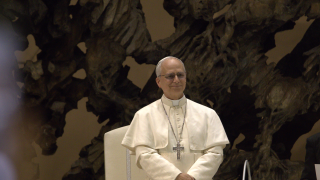
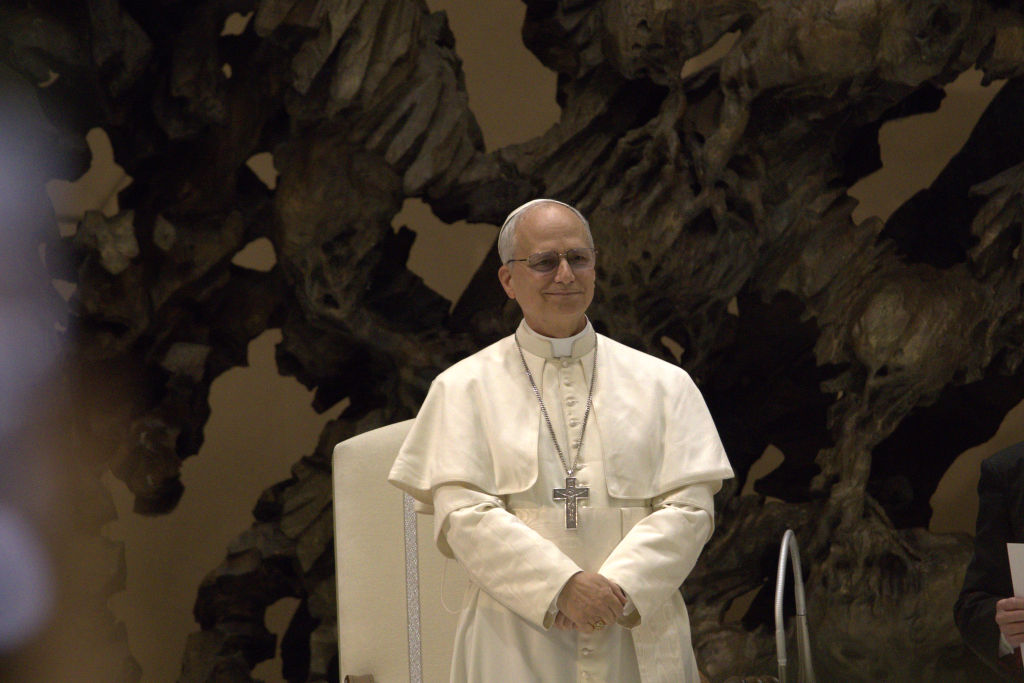
Pope Leo in his white garments smiling
Photograph taken by Edgar Beltrán/The Pillar.

Why do you think it’s important that the Catholic Church weighs in on AI?
At the Vatican launch event, Anthropic co-founder Chris Olah said, “We need moral voices that the incentives cannot bend.” He was describing what the Church can be at its best. “Magnifica Humanitas” comes from one of the world’s most significant civil society institutions, with 1.4 billion members, a presence in communities around the world, and a tradition of thinking seriously about human flourishing that spans centuries and cultures. It also has deep on-the-ground experience accompanying people through major social and economic transformations.

What happens after a pope publishes an encyclical? Does the Church have an action plan for next steps?
What follows an encyclical’s release is a process of reception and implementation across the Church’s institutions: bishops’ conferences, universities, schools, hospitals, social service organizations, and all of us are called to engage with it and translate its principles into practice in specific contexts. Here at Georgetown, many will be involved in doing just that.

What do you think the implications will be of “Magnifica Humanitas”? Do you think this work could influence policymakers?
“Magnifica Humanitas” offers a moral vocabulary and framework at a moment when the public conversation about AI badly needs one. It’s already helping shape the public conversation, offering Catholic institutions, leaders and citizens, as well as all people of good will, a vocabulary and set of criteria for evaluating AI policy. Catholic social teaching has a track record of making significant contributions to global conversations around human dignity and justice, and policymakers and others who engage with this document will find it to be less a set of directives than a set of questions: Does this policy advance human dignity? Does it protect workers? Does it serve the most vulnerable?

How is Georgetown responding to Pope Leo’s encyclical?
As a Catholic and Jesuit university with a commitment to care for the whole person as well as strong leadership on AI ethics and policy, Georgetown is well-positioned to lead national and global conversations around the issues Pope Leo raises in the encyclical and to do the work of translating principles into practice. As one step toward that end, our Initiative on Catholic Social Thought and Public Life hosted a major public dialogue on June 2 with Catholic leaders on these issues. Georgetown’s Center for Digital Ethics brings so much expertise and experience to these conversations, along with many other leaders and faculty members across the university. Georgetown is a natural convening place for the scholars, policymakers and practitioners this conversation requires.