M. Elizabeth Magill, the former dean of Stanford Law School, provost of the University of Virginia and president of the University of Pennsylvania, has been named the executive vice president and dean of Georgetown Law.
Magill will begin her role as the school’s 17th dean on Aug. 1, 2026. She succeeds Interim Executive Vice President and Dean Joshua Teitelbaum, who has led Georgetown Law for the past year after long-time Dean William Treanor stepped down in 2025.
“We are honored to welcome Liz Magill as the new dean of Georgetown Law,” said Interim President Robert M. Groves. “Liz is the right person to lead Georgetown Law. She is a distinguished legal scholar and an accomplished administrator who brings a values-driven vision to Georgetown Law. We are excited to see her take the helm and join our vibrant community.”
Magill, an award-winning legal scholar in constitutional and administrative law, has called law schools her “professional and academic home” ever since she attended the University of Virginia School of Law, graduating in 1995. After clerking for U.S. Supreme Court Justice Ruth Bader Ginsburg, Magill has been a law professor at UVA’s School of Law, Stanford Law School and the University of Pennsylvania for the past 29 years.
She also served as the dean of Stanford Law School from 2012 to 2019. In 2019, she was the first woman to become executive vice president and provost of UVA. In 2022, she assumed the presidency of the University of Pennsylvania, where she continues to be a faculty member at Penn Carey Law. In addition, Magill has served as a visiting professor or fellow at the London School of Economics, Harvard University, Cambridge University and Princeton University.
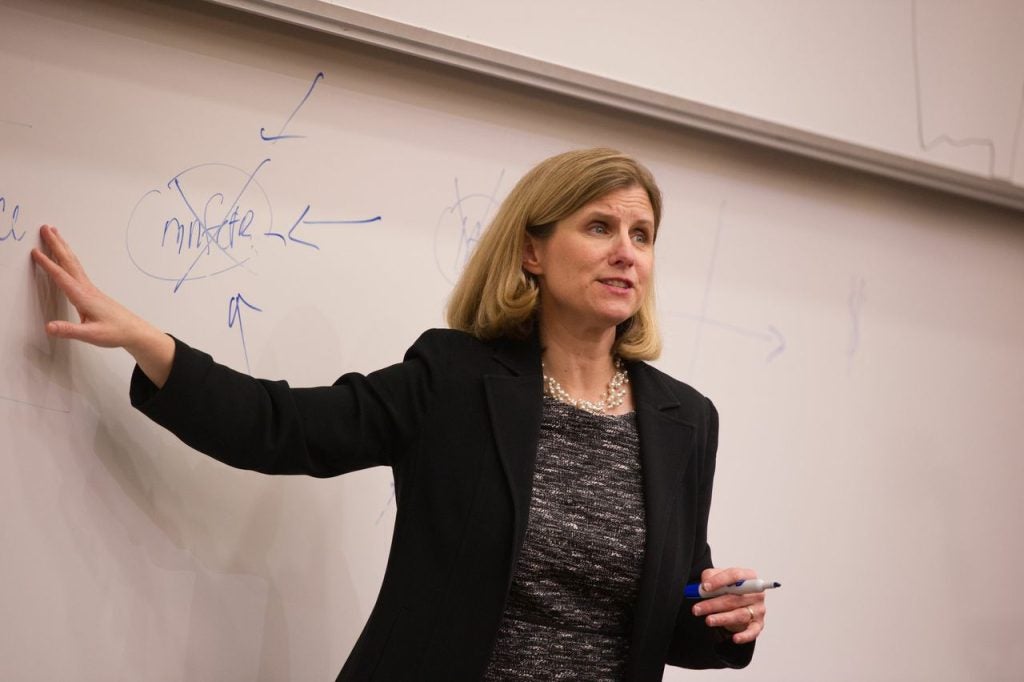
Magill teaches a class at Stanford Law School in 2015 while serving as dean. Photo courtesy of Stanford Law School.
“I am honored to join Georgetown Law, one of this country’s great law schools, and the university, an exceptional and distinctive research institution,” Magill said. “As an academic leader, I have great admiration for the Law Center’s faculty, students’ and staff’s capacity to excel and contribute across a large range of endeavors connected to law — scholarship, practice, policy, national and global reach, education and service. The scale and impact of these many contributions is both remarkable and exciting.”
In joining Georgetown Law, the nation’s largest law school, Magill is returning to her family’s roots. Three of her five siblings have Georgetown degrees. Her father, a former federal judge nominated by President Ronald Reagan, graduated from the School of Foreign Service and Georgetown Law.
“The institution utterly transformed my family’s life,” she said.
Growing Up in a Hoya Family
Magill’s late father, Judge Frank Magill (SFS’51, L’55), attended the School of Foreign Service and Georgetown Law.
Magill grew up in Fargo, North Dakota. She remembers hearing stories about Georgetown from her late father, Judge Frank Magill (SFS’51, L’55), who worked on his family’s farm during the Great Depression and Dust Bowl before attending Georgetown’s School of Foreign Service.
“The School of Foreign Service and the Law Center changed the trajectory of his life,” she said.“He thought Jesuit education was the best education you could possibly get. He was lucky to get it, and his life was never the same. I grew up thinking of Georgetown as a special and life-changing place.”
Magill, the self-described “black sheep” of her family who did not attend Georgetown, studied history at Yale University. After graduating, she worked for North Dakota Senator Kent Conrad as a senior legislative assistant for energy and natural resources in Washington, DC. After four years, she left to attend law school at UVA, where she planned to become a law professor.
After earning her law degree, Magill clerked for Judge J. Harvie Wilkinson III on the U.S. Court of Appeals for the Fourth Circuit and then Justice Ginsburg, who became a role model for her.
“It was like being a kid in a candy store if you like law,” she said.
Magill with Supreme Court Justice Ruth Bader Ginsburg at Stanford University. Photo by Josh Edelson, Stanford Law School.
In 1997, she joined the faculty of UVA’s School of Law, where she later served as vice dean. In the years following, Magill began taking on executive leadership positions in higher education.
“Liz Magill brings the experience and leadership that we need to lead Georgetown Law,” said Thomas A. Reynolds (B’74), chair of Georgetown’s board of directors. “Her ability to connect with others, her humility and her unwavering belief in higher education will make her an exceptional next dean.”
“Liz Magill not only brings impressive experience leading Stanford Law, but she is also an award-winning legal scholar steeped in constitutional and administrative law and published in leading journals,” saidGeorgetown Law Interim Dean Joshua Teitelbaum. “I look forward to working with her in this period of transition. I know Georgetown Law will be in good hands.”
Throughout her career, Magill has served as the dean of Stanford Law School, provost of the University of Virginia and president of the University of Pennsylvania. Photo courtesy of Stanford Law School.
As the executive vice president and provost of UVA, Magill helped lead the school through the challenges of the COVID-19 pandemic. She also led searches for eight new school deans and created a new internal budget system for the university.
In 2022, Magill was unanimously elected by the board of trustees as president of the University of Pennsylvania. During her tenure, she built a strong leadership team and launched a strategic plan to advance the university’s mission. But following the response to her congressional testimony about antisemitism on campus in the fall of 2023, Magill stepped down as president.
Magill said the experience clarified what she sees as the essential task of leadership: stating values clearly and acting consistently on them. She is especially eager to meet and welcome Georgetown Law students.
“Georgetown Law stands out as a community committed to bringing together people of different faiths, cultures, backgrounds and perspectives — a commitment that I’m deeply invested in upholding,” she said. “Georgetown’s Jesuit values — care for the whole person, justice and service — will be my North Star.”
New Chapter at Georgetown Law
Magill was eager to return to her professional and personal roots in law. Georgetown Law, the 156-year-old law school in downtown Washington, DC, attracted her with its mission, DC location and talented faculty and students, she said.
“Georgetown has an unmatched combination of great attributes: its size, impact and location,” she said. “The impact it has always had and will have in the future is unlimited. That’s an exciting opportunity and challenge to figure out how to build on the enormous excellence and strengths of the school.”
Magill plans to expand on and advance Georgetown Law’s strengths, particularly during a time of global challenges in changing technology, foreign affairs, national security issues and challenges to the rule of law.
“I’ve long admired Georgetown Law’s motto: ‘Law is but the means; justice is the end.’ That sense of purpose is woven into the life of the school — a clear expression of Jesuit values,” she said. “I have great aspirations for the Law School’s future; this is the time to build on excellence and become an even stronger school.”





 Magill was eager to return to her professional and personal roots in law. Georgetown Law, the 156-year-old law school in downtown Washington, DC, attracted her with its mission, DC location and talented faculty and students, she said.