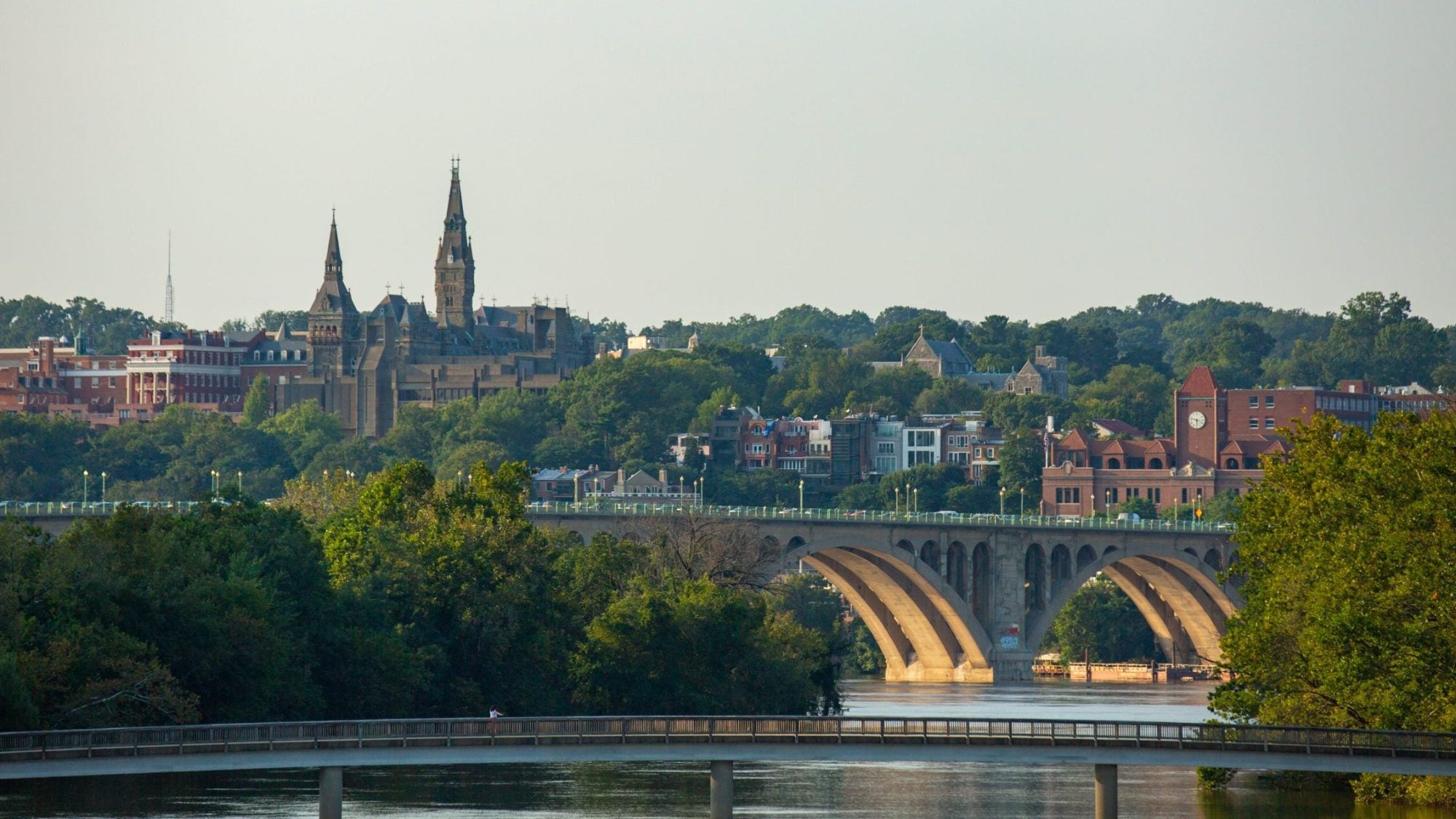
Georgetown's skyline from the Potomac River and the Key Bridge
Category: University News

Title: Georgetown Named No. 1 Producer of Fulbright Student Awardees

Georgetown students and alumni have won the highest number of Fulbright grants out of any other college or university in the U.S. this academic year, the Fulbright Program announced today.

The designation makes Georgetown the top producer of student awardees in the country for the Fulbright U.S. Student Program — the fifth time since 2019. 

Forty-two Hoyas received Fulbright grants with placement offers in 25 countries around the world. Nearly 600 Georgetown awardees have taken part in the Fulbright program since 1949. 

“On behalf of Georgetown, I want to congratulate this year’s 42 Fulbright recipients,” said Interim President Robert M. Groves. “Through their extraordinary scholarship, teaching and engagement, they are advancing cross-cultural connections and Georgetown’s commitment to the common good.”

“We are honored to have this distinction and deeply proud of our students.”
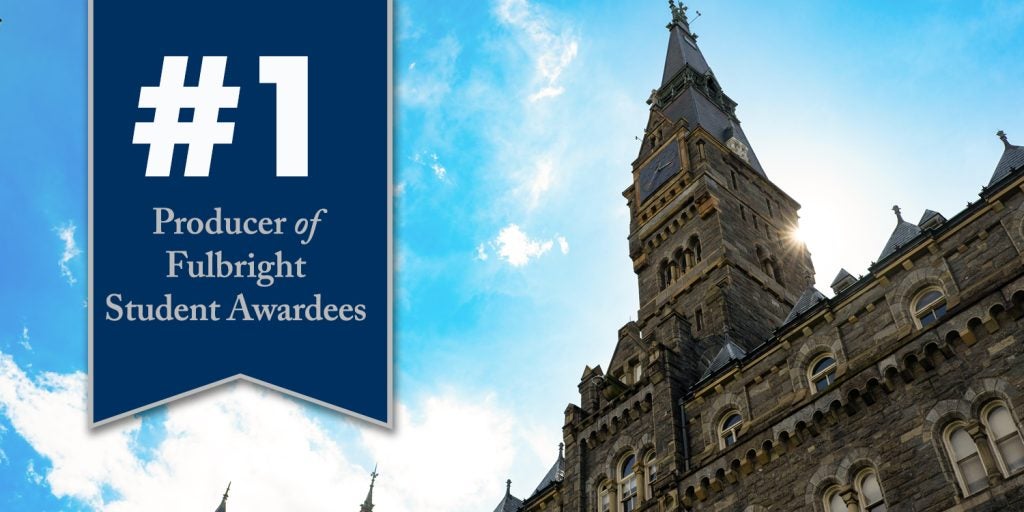
A graphic that says "#1 Producer of Fulbright Student Awardees" with an image of Georgetown's clocktower behind it
Over the past decade, Georgetown has consistently ranked among the top five research institution producers of Fulbright student awardees.

The U.S. State Department’s Fulbright program, celebrating its 80th anniversary this year, selects students to study, teach English or conduct research abroad to build international connections, exchange ideas and address global challenges. 

Over the past decade, Georgetown has consistently ranked among the top five research institution producers of Fulbright student awardees. 

This year’s cohort includes a graduate student and recent alumni from the School of Foreign Service, the School of Health and the College of Arts & Sciences, who are researching, studying or teaching from Japan to Zambia.  
Two women stand on a beach and hold a sign that says "Fulbright"
Passariello with a fellow Fulbrighter at their midterm reunion in Huatulco, Mexico, in early January.

“We sincerely congratulate all of the grantees and are so grateful that their inspiring dedication has been recognized in such an impressive way,” said Bill Cessato, deputy director of the Center for Research & Fellowships. “We’re energized by the way Hoya Fulbrighters thoughtfully collaborate with communities globally while actualizing Georgetown’s values, including academic excellence, community in diversity and people for others.”

For recent graduates like Daniella Passariello (SFS’23, B’23) and Rushil Vashee (SFS’25), the Fulbright has immersed them in Mexico City and New Delhi, respectively, expanding their undergraduate research and interests, learning and working in a foreign language, and gaining a valuable global perspective. 

“Georgetown teaches us exactly how to be culturally conscious and seek out these global opportunities,” Passariello said. “[The Fulbright] is like a free golden ticket to be able to experience my dream job.”

Learn more about these two Fulbrighters’ experiences and research abroad. 

A Return to Her Academic and Personal Roots

Passariello, who graduated from Georgetown in 2023, began the Fulbright Binational Business Program in Mexico City with a nagging question: Was her interest in Latin America professional or purely personal? 

It was a tough question, as the two had been intertwined. 

Passariello grew up in a suburb of Caracas, Venezuela. Over time, she noticed businesses and friends leaving the city; her own family moved to Miami when she was 10. She wanted to understand what was happening — why long lines surged out of the supermarket or why she had to stuff a whole purse with cash to buy a movie ticket — and how the international community could help.
Two women pose for a picture in front of a beach
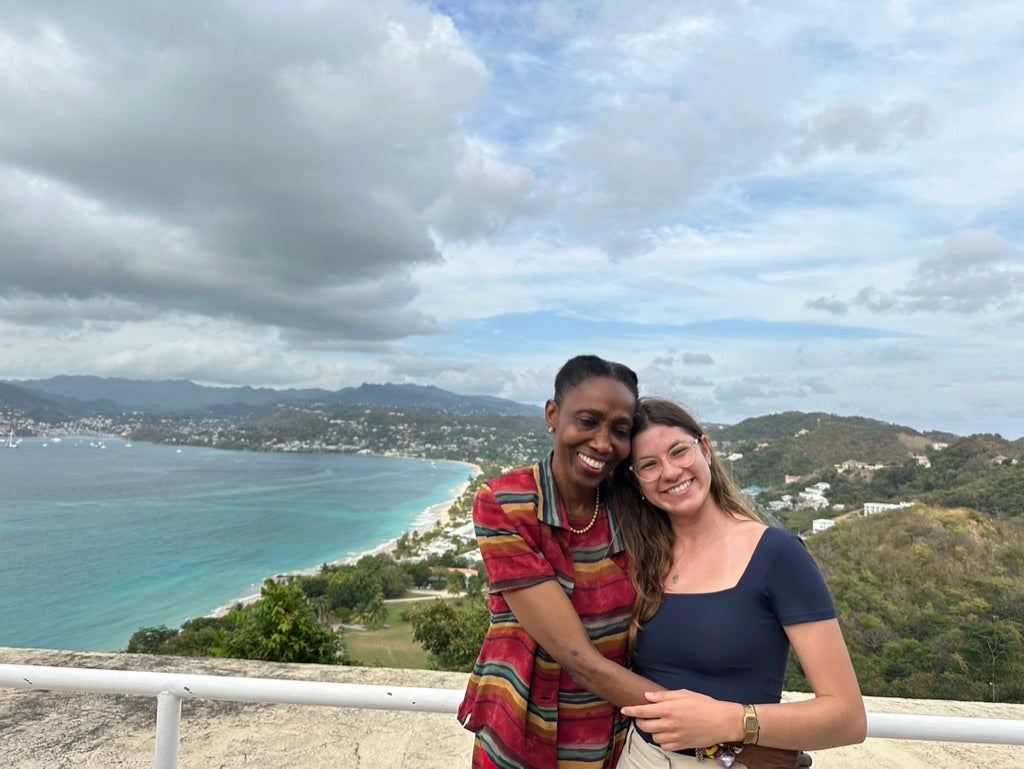
Passariello (right) with Dessima Williams (left), president of the Grenada Senate and the Visiting Distinguished Professor of Global Perspectives in the Center for Latin American Studies, during a class trip to Grenada in 2023.

She studied in Georgetown’s Business and Global Affairs Program and worked as a research assistant in the Center for Latin American Studies (CLAS), where she helped plan a class trip to Grenada with the course instructor who was the president of the Grenada Senate. Along the way, her interest expanded from Venezuela to include all of Latin America and the Caribbean.

When Passariello graduated, she began working for an investment firm in New York City. Suddenly, she felt cut off from her Latino community at Georgetown and her Latin American research and studies..

“I started feeling like something was missing, and I kept going back to wanting to discover that Latin American identity,” she said. 
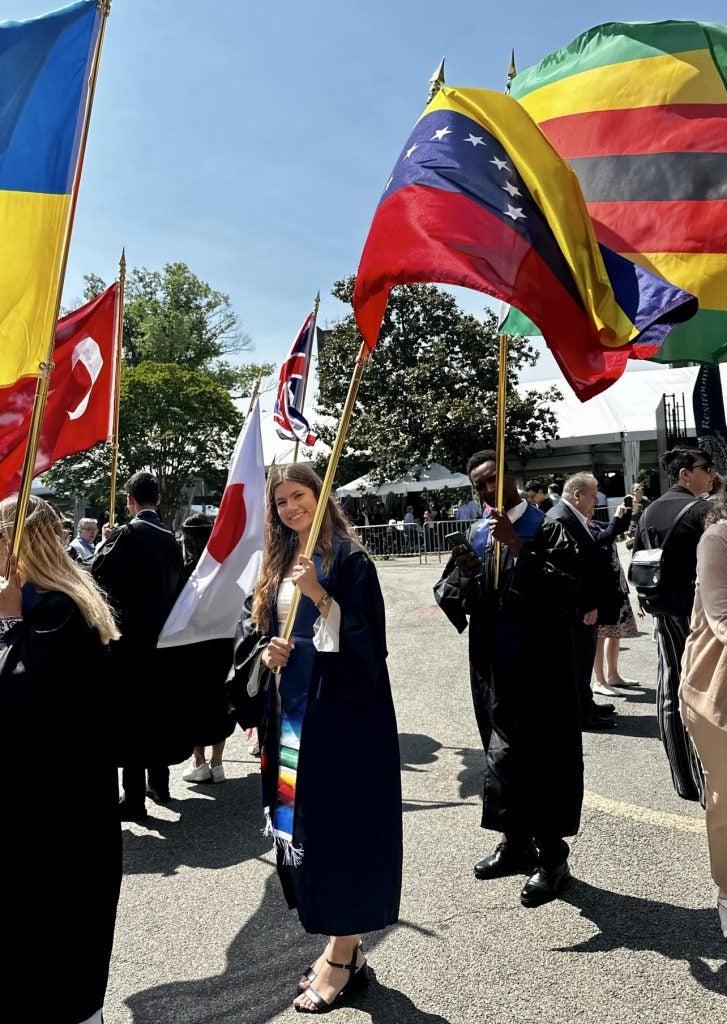
A student holds a flag during a graduation ceremony
Passariello graduated from the School of Foreign Service and School of Business in 2023.

Her mentor from CLAS suggested she spend a year living in a Latin American country, so she could put the question to rest.

She applied to the Fulbright program, and, last fall, moved to Mexico City, where she began working as a financial analyst for the Mexican Fund for the Conservation of Nature and taking master of business administration classes at a local university. The answer came easily.

“I’ve been here for five months, and this experience has already taught me so much and opened so many doors for me,” she said. “I found something I thought I had lost in New York, which was my Latin American identity. Being able to find that again has felt so meaningful that I don’t want to let go of it ever again.”

In her role, Passariello is working on a whitepaper the team plans to present at the next United Nations Biodiversity Conference. She’s researching how effective biodiversity financing is for conservation trust funds and for biodiversity outcomes. She also helps her team build proposals to fund environmental projects in Mexico. 

The work weaves together her financial skills and her minor in Environmental Studies at Georgetown. She said Georgetown’s focus on global opportunities prepared her for the experience, one she hopes fellow first-generation and low-income college students in the Georgetown Scholars Program (GSP) will reach for too. 

“A lot of low-income students think that we have to start working immediately so we can help our families,” she said. “I want this story to show GSP peers, I’m doing it, I’m loving it and it was 1,000% worth it. It will definitely set me up for life — for my professional life to be the way I want it to be.”

Expanding Financial Access

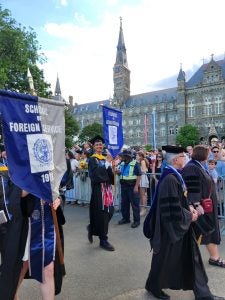
Students dressed in graduation robes and caps process across Georgetown's campus carrying flags
Rushil Vashee graduated as the valedictorian of the School of Foreign Service in 2025.

For Rushil Vashee, the Fulbright-Nehru Student Research Grant has helped him deepen his research on an understudied topic he explored during his undergraduate years. 

Vashee lives in New Delhi, India, and is using his nine-month Fulbright grant to better understand the behavioral and institutional factors that influence access to economic systems. Specifically, he’s studying India’s Unified Payments Interface (UPI), in which users can pay each other instantly by scanning a QR code. The UPI system has proven more successful than net banking, or online banking, in India, he said. 

“The latest survey data shows that about 12% of Indians are able to perform online banking transactions through net banking, while nearly 70% can perform such transactions through UPI,” Vashee said. 

“So I was trying to understand, why is there this huge jump between people who, for the large part, are not using net banking, but then are using this UPI system? What are the intrinsic characteristics of UPI that made it accessible and usable by so many people?”

To find out, Vashee has been traveling across India interviewing rickshaw drivers, street vendors, elders, small business owners, academics and thinktank experts. At the same time, he’s researching national survey data on UPI usage and building out a quantitative model for articles and presentations. The interviews, he said, will help him better analyze the data and determine which factors to include in his quantitative model. 

The results could shed light on the factors that allow people to more easily participate in digital payment systems and in social services more broadly, helping policymakers increase access to these programs around the world, Vashee said.

“If I can get data that shows that it is representative on a larger scale, then what are the implications for an unemployment application form in the U.S. or something totally unrelated in a different country?” he said. “That’s a question that could dramatically change how many people access these really important services.”

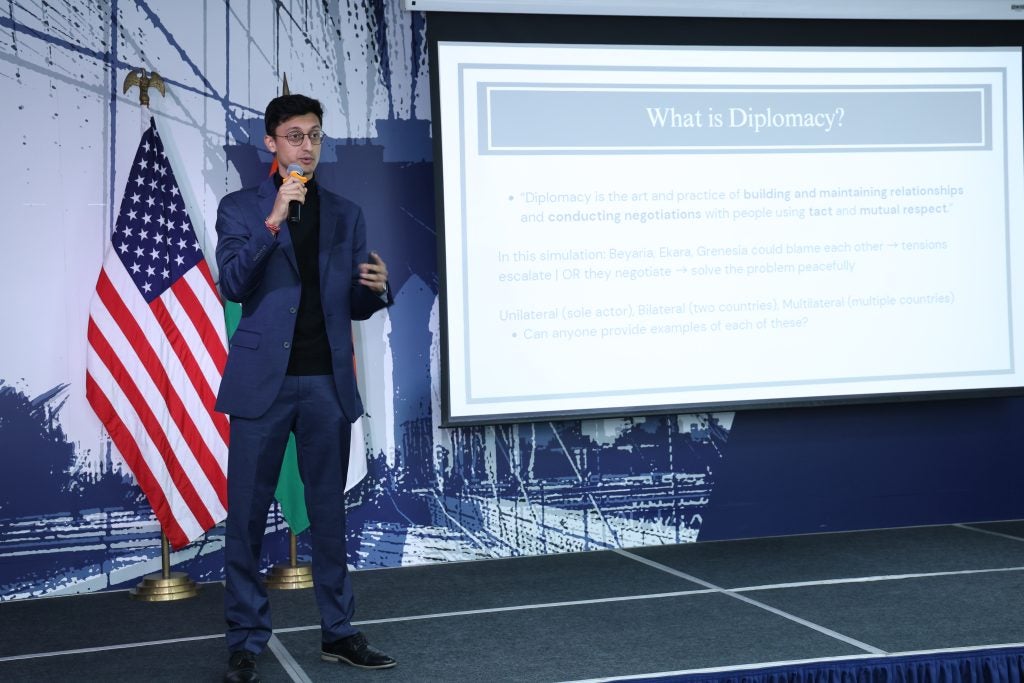
A man in a suit stands in front of an American flag and a screen on a stage
In January 2026, Vashee facilitated a diplomacy simulation on counterfeit trade at the U.S. Embassy’s American Center in New Delhi.

Vashee first became interested in economic access while studying abroad in Quito, Ecuador, his junior year. He struck up a conversation with an Uber driver who worked two jobs to make ends meet. They talked about income inequality and pessimism about Ecuador’s economy.

“I started paraphrasing solutions from my undergraduate classes: expand conditional cash transfers, build more bank branches, guarantee basic employment,” he said. “He just stared at me and was like, ‘We can’t. They’re all corrupt.’ 

“This moment was the first time it hit me in the face and made me realize that you can study access with as many different factors as you want, but unless you include this kind of amorphous, difficult-to-quantify aspect of trust and personal opinions, you won’t get the full picture.”

When Vashee returned to the U.S. in 2024, he interned at the White House Council of Economic Advisers, where he applied his learnings to provide in-depth quantitative and qualitative economic analysis to senior economists and research assistants.

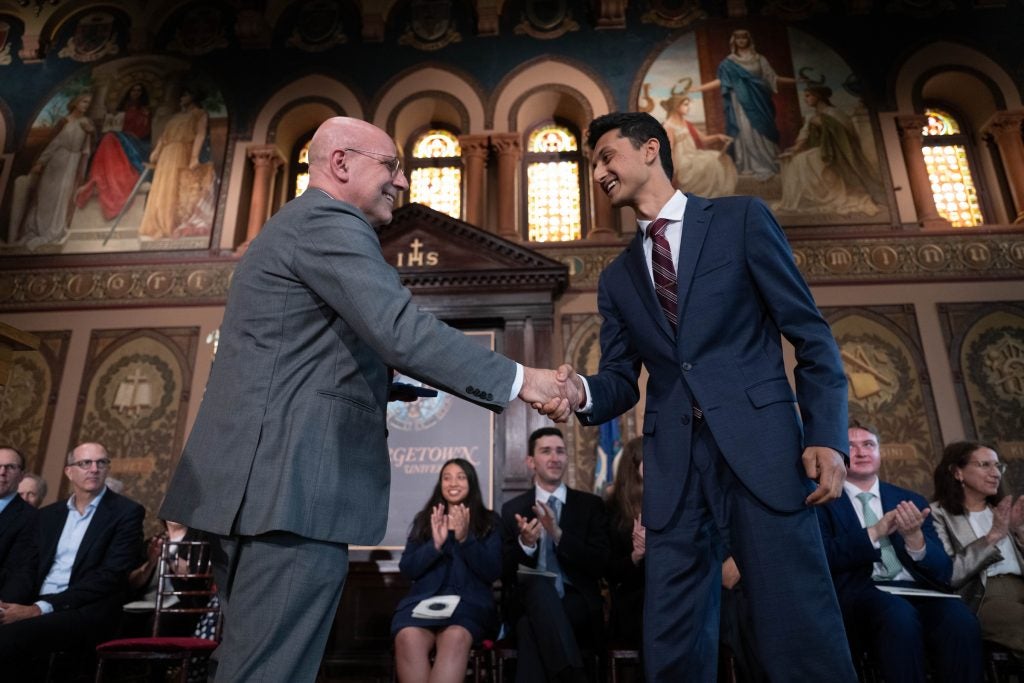
Two men shake hands on a stage in Gaston Hall
Vashee accepts the Dean’s Medal from Joel Hellman, dean of the School of Foreign Service, during the SFS Tropaia Ceremony on May 16, 2025.

After graduating as the valedictorian of the School of Foreign Service, Vashee moved to India, where he expanded this idea of economic access to include other determinants: physical infrastructure, transparency, digital literacy and behavioral characteristics.

Vashee has found his journalism minor at Georgetown has prepared him well for on-the-street interviews. Vashee, who began working as a sports writer for USA Today at age 17, said that classroom learnings on establishing trust with interviewees have proved crucial.

But what prepared him the most for the Fulbright, he said, was Rangila, a South Asian dance showcase and philanthropic event run by students at Georgetown. Vashee served as a senior coordinator for the event and choreographed dances.

“I almost see dance as similar to journalism in that it gave me another tool for how to understand people and understand cultures,” he said. “Through dancing, I feel like I built communities and built an understanding of how people live and what’s important to people.

“That, I think, is a core challenge of Fulbright: to develop the deep understanding and long-term relationships that underpin mutual understanding.”

Two students perform a dance at a South Asian showcase.
Vashee performs at the 30th anniversary of Rangila in 2024.