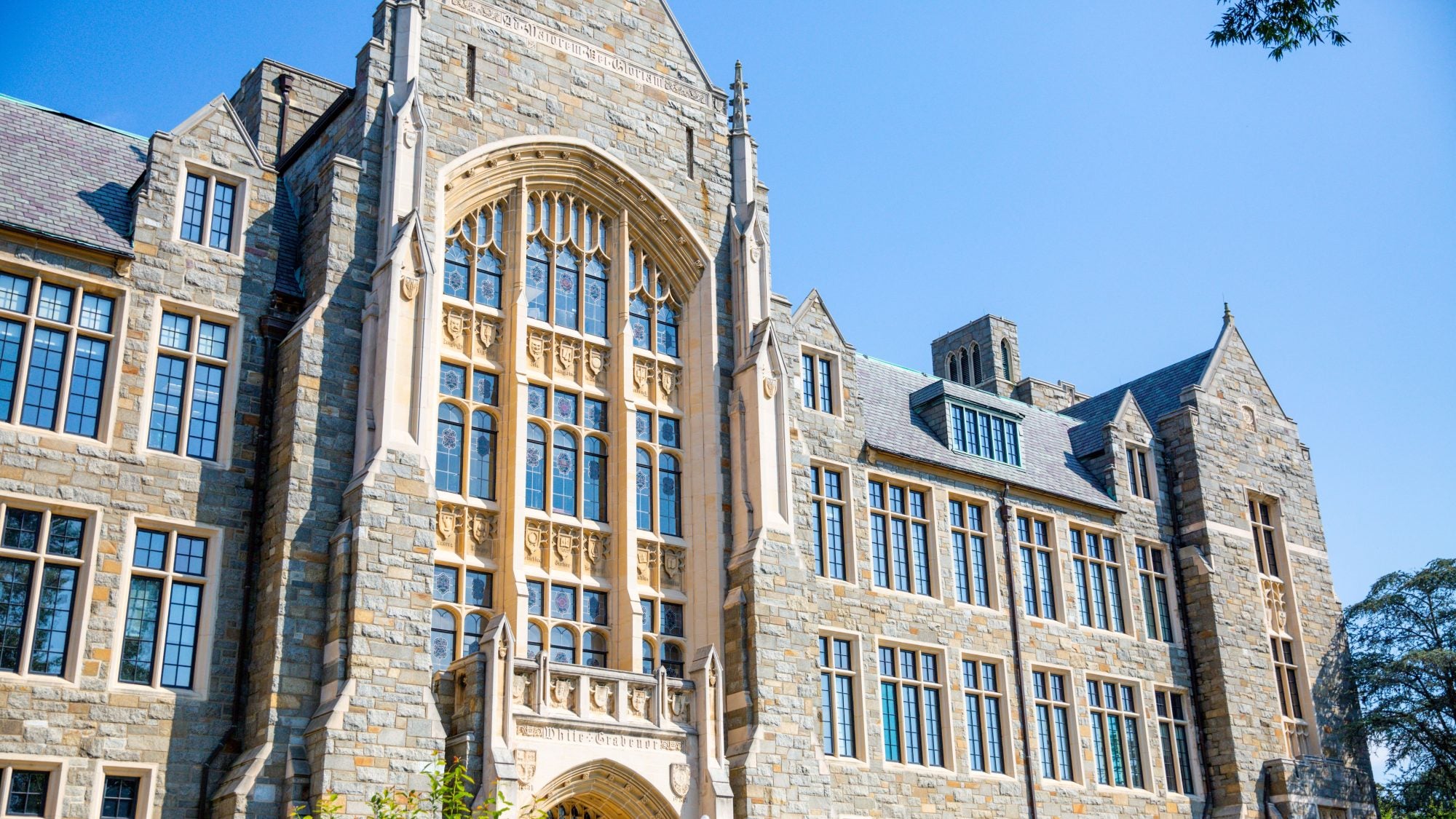
The summer before freshman year is filled with questions: Who will my roommate be? What dorm will I live in? What clubs should I join? Are these sheets twin or twin XL? Why does Georgetown use so many Latin phrases? Another daunting milestone comes in July, when you sit down to register for classes. I will never claim to be an expert on dorm decor, but I can give my best advice on how to set yourself (and schedule) up for success.

Fill Your Cores
The best way to begin your journey at Georgetown is to dive into the Core Curriculum. The Core is a two-tiered program, with one tier shared across campus and the second determined by your school. We only have so much time, so for now I’ll focus on the first tier (see here for details on your school-specific core). The shared core’s requirements are:
- Two philosophy courses
- Two theology courses
- Two writing courses
- One course in Humanities: Art, Literature, and Cultures (HALC)
- One Science for All course
- One class in Quantitative Reasoning and Data Literacy
- Three Pathways to Social Justice (PSJ) courses (including Race, Power, and Justice)
Some of these cores may be easier to fill than others once you begin the journey to declaring your major. For instance, as an American Studies (AMST) and Women’s and Gender Studies (WGST) major, almost every course I take falls into HALC or PSJ, but I keep insisting that I will just figure out Science For All “later” (it is now later). Be mindful of the general path you’re going on, and maybe opt for the requirement you may be unlikely meet with your major/minor! Also, if you took AP or IB classes in high school (or another international program), figure out what credits transfer! I took no writing classes and only one history class based on my AP credits.
I also recommend that if you do know what major you intend to pursue, or feel pretty sure, try to align your core classes with major requirements! Because I knew what I was interested in early on, I aligned many of my core classes with my majors. I also got elective credits for my major while completing my core through classes like Women and the Hebrew Bible (theology and WGST) and U.S. Political Systems (social science + AMST).
I will also add a slight asterisk here: if you intend to study abroad, leave some core classes for then! While you may not always be able to find a ton of classes that will fit your major requirements while abroad, you’ll likely find a philosophy or theology class at the university.
Aim for Connections
If you’re an introvert, you may want to keep scrolling. The academic part of your first semester is super important, but making friends is also crucial. That’s why I’d recommend taking classes that allow you to talk to the people around you and make connections! First-Year Seminars are a great opportunity, as are smaller, discussion-based classes (think writing, English, theology, philosophy, etc.). You can view class size when registering for or previewing classes in GUExperience. Sometimes getting a spot in a small class is simply not possible, and that’s totally ok! But if you have the opportunity, I’d recommend it.
Do What You Need to Do
It’s also important to use your first semester to acclimate to Georgetown academically. For me, this meant two important things: taking a writing-heavy class, and making sure I’d never take a math class again. Both of these goals were dictated heavily by my high school experience. My AP English teacher recommended taking a writing class first semester because we had written all year in her class and would feel comfortable in a college writing class amid a lot of change.
For you, this might mean taking a class where all you’re doing is crunching numbers, or taking a history class on a subject you are already super interested in. Having something comfortable and easy, though, can be a lifesaver and a nice respite from the hectic nature of freshman fall. I didn’t need to take a writing core (thanks AP credit) but I still enrolled in Intro to Journalism to exercise that muscle — it felt like I was learning new things while falling back on what I think I’m best at (writing).
In terms of what I’m worst at, math is probably up there. While I also took AP Calculus in high school, I did not secure a high enough score for my AP credit to transfer (my teachers tried their hardest with me). I knew that taking calculus would hang over my head for all of college, so I just got it out of the way at the beginning. The good news is that the Quantitative Reasoning and Data Literacy requirement allows for more flexibility in what was once the math requirement. However, if you have your own calculus — whatever subject it may be — getting it out of the way in the first semester ensures that it won’t hang over you for the rest of college.
Explore Majors
If you come into Georgetown unsure of your major/minor, take an elective class first semester in a major that interests you! You may love it, and you also may hate it — both reactions that will help lead you on the path to the right program for you. It may take you multiple semesters to get in a groove, and that is totally ok. The important thing is to start feeling things out and get a sense of what things you value in a major/minor.
Registration seems scary, and in some ways it is. However, the beautiful thing about a semester is that it’s just that: a semester. You’re not locked into these classes for the rest of college, or even the rest of the semester — the add/drop period is there for a reason! So take a deep breath, research your classes, and buy the twin XL sheets (and make sure to wash them).