How does climate change impact bird populations?
We’re definitely seeing impacts of climate change, but most extinctions or major declines that have happened don’t appear to have been due to climate change. They’ve been a result of habitat loss, invasive species, contaminants and overharvesting by humans.
Birds are definitely being impacted by climate change. Whether they’re adapting to it or not is unclear. We definitely see evidence for some types of change, but change doesn’t mean it’s adaptive. We’re seeing body size differences evolving over time, but we can’t assume just because a bird changes its behavior relative to increasing temperatures or decreasing precipitation that it’s an adaptation. It might be a response, but it could be a negative response.
Some research has shown a negative link between birds and agriculture. Why is agriculture correlated with declining bird populations?
When you look out your window, what do you see? What was there before the houses, buildings, farm lands and pavement were there? There were probably trees, habitats, all sorts of birds, insects and mammals used. Now that’s taken out of the equation. When you fly across the country, you see human-dominated habitats, buildings and landscapes. When I look out of my office, I don’t see any natural habitats left.
Agricultural fields are the same thing. When you change the land use from a natural habitat to a monoculture of corn, soybeans or whatever it happens to be, together with pesticide use, those areas are no longer suitable to maintain a healthy population of whatever animal it might be.
What happens when birds lose their habitat?
Birds have evolved to live in certain conditions. Birds have certain requirements in terms of where they build nests or the kind of food they eat. Some birds are very specialized. In a cornfield where you have pesticides killing insects while the seeds are coated in neonicotinoid, which is a natural pesticide, those insects can’t live in those situations. If you don’t have insects — and many birds are insectivorous — there’s nothing for birds to eat.
You can’t have a duck that lives in a marsh and all of a sudden put that duck in a field. That duck specializes in foraging in a pond and is sifting with its bill through duckweed and other sorts of plants to get insects.
Birds can’t adapt overnight to living in a totally different habitat. All birds are somewhat specialized for where they live. Some are more generalist than others. Starlings are pretty generalized, but they like urban areas. You don’t see them in the forest. Robins like lawns because they can eat worms and things, but you don’t commonly see them in deep forest either. When we change those habitats to something less natural, you don’t typically get many species in those areas.
Why can’t birds fly to a new but similar habitat?
There are probably already birds of that species in other areas, so there’s no other place for those birds to go. It’s called carrying capacity. There’s only so much food in that site. As we deplete the habitat, birds will settle at the carrying capacity of the overall landscape.
How do you balance conservation with the need for agriculture to sustain a growing human population?
This is the crux of a lot of sustainability issues. A lot of people would say we have enough food on the planet. It’s just a question of getting food to people in ways that are equitable. The second thing I would say is that we have a lot of food waste.
I would also say that we’re probably over our carrying capacity in terms of the number of people on the planet. We’re at over 8 billion people. We can’t keep growing beyond the capacity of what the Earth can sustain.
People like Pope Francis understood this when he published Laudato Si’ in 2015. We have to care for all living things, including ourselves. In some cases, this means we need to figure out how to live within our means. This is why thinking about environmental issues is integral to everything we do on the planet. It’s easy to keep it out of sight, out of mind, but at the end of the day, this is the legacy we’re leaving. We’re leaving a legacy of an Earth in poorer shape than we found it for the next generation, and that’s not okay.
Are all bird species declining or are some hit harder than others?
A lot of bird species are not doing well, but there are definitely some species doing better than others. Waterfowl like the ducks in North America tend to be doing better in part because they’re game species. Hunters over the last 30 to 40 years have done a good job of making sure that their populations are maintained. They have figured out ways to raise money from hunters, who are treating the ducks as a resource to buy things called duck stamps, which provide money every year to buy new habitats and keep the quality of habitats high.
It’s all the other species that are not hunted, where there are no finances to protect their habitats, that are taking it on the chin. A lot of the grassland species, where those grasslands have been turned into agriculture, like in the Midwest, or species like shorebirds that exist along the coastal areas where we’ve built a lot of houses, those are the species where there are lots of problems.
What policy solutions might help stem the loss of bird populations?
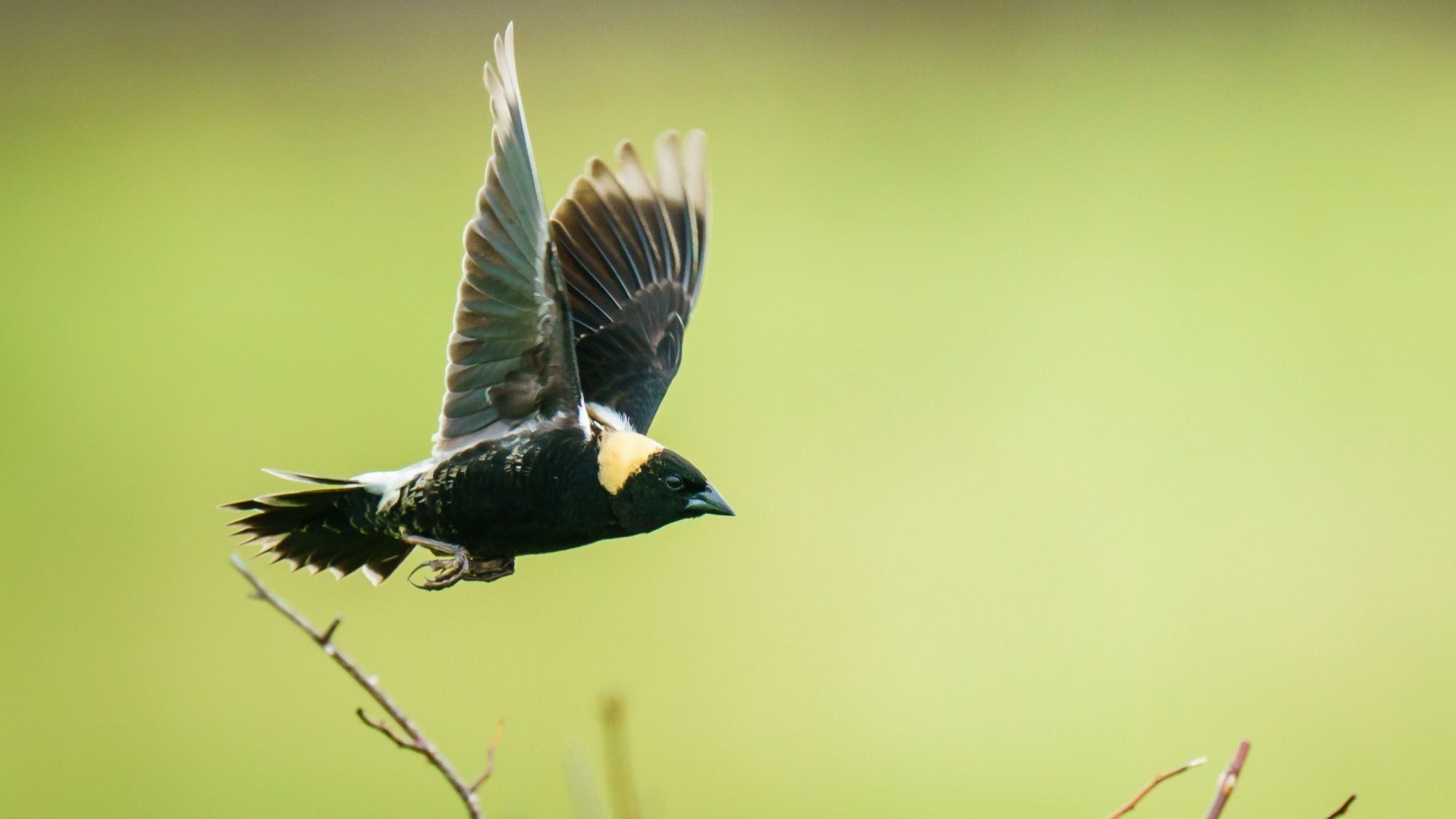
Part of the issue is figuring out the details of a particular situation. For example, there might be particular areas where farming could be an issue, maybe there are changes to agricultural practices we can recommend such as farmers not cutting their fields at certain times. Bobolinks, for example, are a cool species of blackbird that breed in complex grass fields that are used for hay. If farmers don’t cut their fields until July, those bobolinks can reproduce successfully. If they cut their fields in May or June, they’re bulldozing their nests. There are modifications that can be made that are beneficial for the birds and farmers.
In California, there are rice fields that are flooded at certain times of the year for the growing of rice, but they can also be flooded at other times of the year for other purposes. Rice fields provide important shorebird habitats and are important for farming too. By slightly modifying the timing of when they’re flooded and doing this at times of the year when birds are migrating, we can provide good wetland habitat for migratory birds that require those habitats on their way south.
There are incentives that can be provided as well. One federal program called the Conservation Reserve Program provides incentives for farmers to leave a certain amount of buffer of natural habitat around their fields to provide for animals a safe place to persist. It’s these sorts of compromises and programs that will be necessary if we want to find some happy medium for people and nature to both thrive.
Can designating more natural habitats as protected land be an effective solution?
Area-based conservation or land protection is one of the largest programs out there for saving nature. But for many species, it’s not sufficient because it doesn’t protect migratory birds or birds that move long distances. Birds might breed up in the high Arctic and migrate all the way down to the tip of South America. Along the way, they’ve got all these migratory stops that they depend on to refuel, escape predators or just rest.
It may be that only 10% of the places a bird uses in its annual cycle are actually protected areas. When you think about the land out there, some of it’s protected and some of it’s privately owned. If it’s private land, no one says you have to manage it in a certain way, so it might not meet the needs of migratory birds.