Early on in her internship at L’Oréal, Megan Malhame (B’15) found that her minor in classical studies set her apart.
The alumna was inspired by illustrations in her mythology textbooks, and, years later, continues to bring this creativity to her day job as director of L’Oréal skincare for Walgreens.
“It just goes to show that you don’t have to be the quintessential in-a-box kind of archetype. You can do things that are different,” she said.
Danyel Semple (C’15), an attorney at a record label who works with Billie Eilish and Kendrick Lamar, found her sociology degree helped her contextualize and understand the business landscape and her artists’ backgrounds.
Hear from four alumni, whose liberal arts majors led them in unexpected directions — and helped them get where they are today.
Skincare and Mythology
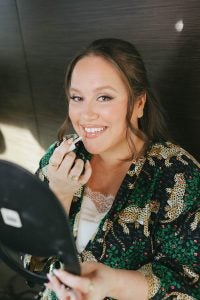
Alumna Megan Malhame (B’15) oversees L’Oréal’s Garnier, Thayers and L’Oréal Paris skincare lines in Walgreens. She ensures its products hit their sales targets in stores across the U.S.
Malhame has risen through the ranks of L’Oréal since interning there in college. She’s wielded her marketing background from the School of Business, analytics know-how and long-time passion for beauty. But she has another tool in her back pocket: her classical studies minor.
“When you delve into [mythology], you see there are more interpretations. There are more ways to go about things,” she said. “I think that mindset helps a lot, especially if I encounter a tough business situation or I want to go about a launch plan in a different way. The creativity of classical studies, the creativity of beauty, they do meld together in that way.”
The Long Island native grew up fascinated by both mythology and beauty. She’d pore over books about Greek gods and goddesses and ad campaigns in fashion magazines. Malhame chose Georgetown for its marketing and classical studies programs, and found that both tracks allowed her to deepen her passions.
When Malhame interned at L’Oréal, her classical studies minor set her apart, she said. She created a website of branding and lifestyle opportunities for the company that was inspired by imagery in her textbooks.
“When you go into a place like beauty, it’s being able to take this out-of-the-box thinking, getting into the artistry of it all,” she said. “How do you go outside the written lines and do something a bit different than what was originally expected? That happens every day in our job.”
To this day, she still finds she uses her classics studies minor in her day job.
“It just goes to show that you don’t have to be the quintessential in-a-box kind of archetype. You can do things that are different,” she said.
Literature and Treating Patients
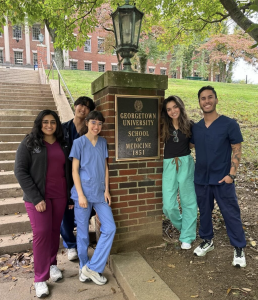
Michael Sobalvarro (C’16, M’29) is a rising third-year medical student at Georgetown.
These days, his bachelor’s degree in English may seem a far cry from pharmacology and orthopedic spine research. But Sobalvarro finds the two worlds interconnected.
“When you’re an English major, you’re given a book or a collection of stories, and your job is to synthesize and organize seemingly random collections of stories into a coherent argument or take,” he said.
“It’s the same thing when you’re a detective in medicine. It’s a story, essentially. The patient has this history, they’ve taken this drug and your job is to synthesize what seem to be unrelated things, pull the most important detail, and come to a diagnosis and a treatment plan. It’s the same thing I used to do in English class.”
Sobalvarro caught the medical bug early on. Growing up as the oldest son of Nicaraguan immigrants in Silver Spring, Maryland, he watched his parents struggle to access medical resources. He found himself wanting to heal and take care of them.
“I wanted to be the doctor my parents never had,” he said.
But when Sobalvarro arrived at Georgetown, he struggled with his biology courses and pursued an English degree instead. He felt most at home in the English department, where he excelled in class, writing and analyzing new worlds.
After graduating, Sobalvarro returned to his medical track, taking pre-medical courses at the University of Maryland and completing the Georgetown Experimental Medical Studies baccalaureate program before enrolling in the School of Medicine.
Nowadays, he finds his English degree gives him a superpower in his studies now and in his future role meeting with patients.
“It’s one thing to diagnose a patient. It’s another thing to break down that diagnosis into terms they can actually use. To educate them so they leave feeling empowered, not scared. The clinicians I admire most are those who use images and stories to make a diagnosis less frightening, more digestible. You can see it. Patients walk away calmer. They feel in control of their body again.”
Recently, a friend asked Sobalvarro if he would still major in English, given his roundabout path to medical school.
“Absolutely,” he said. “The English department taught me that the most important stories are often the ones that go untold, and medicine is full of those. Patients carry narratives that sometimes never make it into a chart. Learning to listen for them, and to honor them, is something I trace directly back to my time in that department.
“I believe that to be a good physician, you first have to be a good person, and that’s where I grew the most as an undergrad. I’m still a work in progress. But the world calls on different kinds of healers, and I’m grateful to be becoming one of them.”